How much does a website cost? A breakdown by scope


Key takeaways:
- Who builds the site sets the starting price. DIY plans are billed monthly, while freelancers and agencies quote per project.
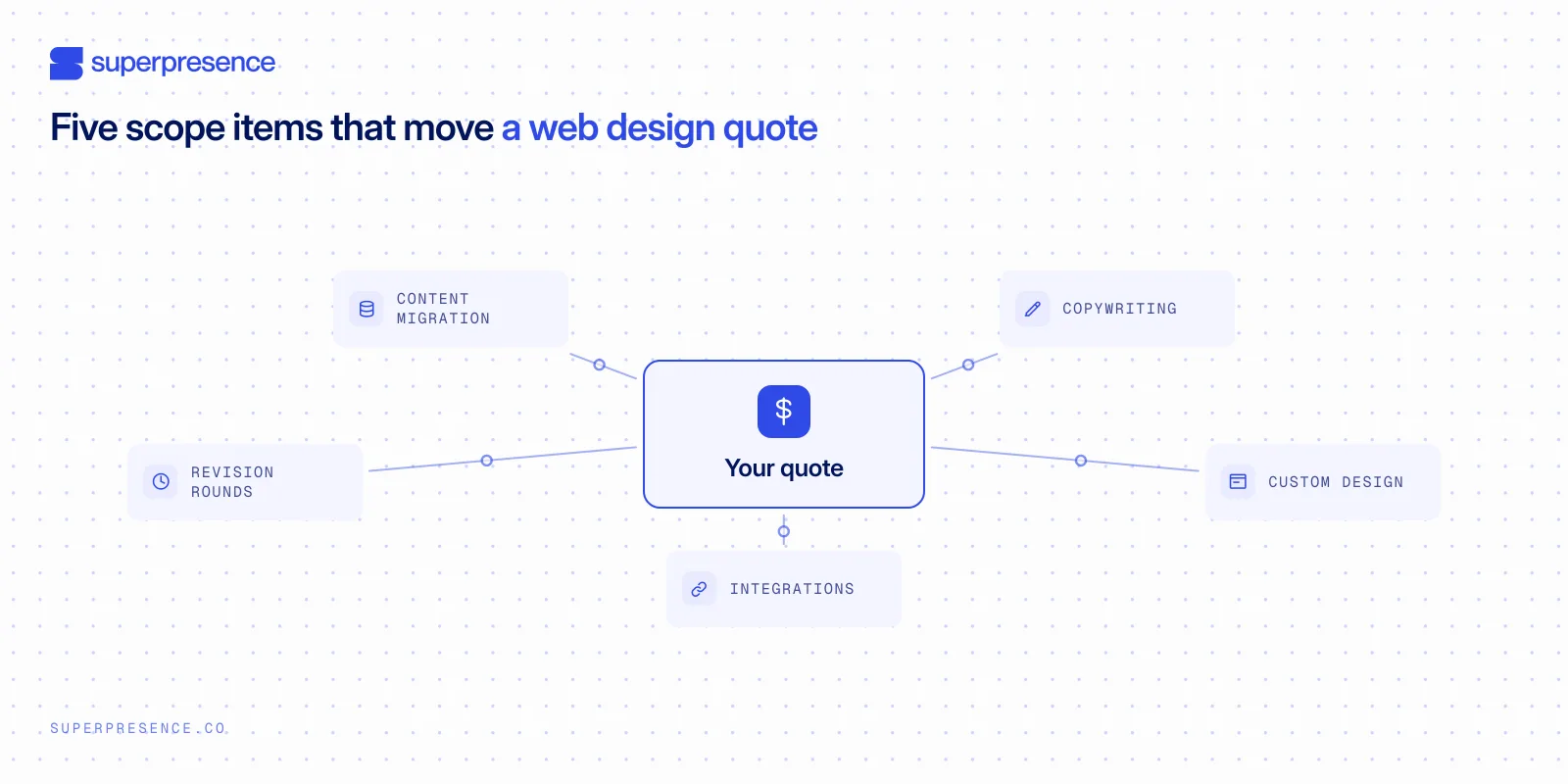
- Five scope items move a quote the most: copywriting, custom design, integrations, revision rounds and content migration.
- A complete quote names who owns the platform account, the domain and the analytics.
- A bigger budget buys the work that moves rankings: site structure, schema and pages planned around what buyers search.
- On a simple brochure site, a freelancer is usually the better buy.
Last updated October 2026
A website costs anywhere from about $15 a month on a do-it-yourself (DIY) builder to $35,000 or more with an agency. All prices here are in USD.
Where your project lands in that range depends on two things: what the site has to do (scope), and who does the work (provider). Once you can see both, you can read any quote on your desk and judge whether the number is fair.
Already holding a quote? Jump to How to read a web design quotation.
What a website costs in 2026
There's no single average cost of a website, because the price depends on who builds it. Here's what each type of provider charges:
| Who builds it | How it's priced | Typical price | Best for | Watch for |
|---|---|---|---|---|
| DIY builder | Monthly plan | $15 to $25/mo on Webflow, $17 to $159/mo on Wix | Testing demand, simple sites | Your own hours: 60 hours at $100 an hour is about $6,000 of your time (Elementor) |
| Freelancer | Per project | $500 to $10,000 | Brochure sites, simple stores | One person means no cover when they're ill or busy, and copy is often excluded |
| Agency | Per project | $5,000 to $35,000+ | Business sites that need to win enquiries and connect to other tools | A higher starting price, which pays off only when the site needs strategy, copy and integrations |
| Large agency | Custom quote, often in phases | Web apps $50,000 to $150,000+ (Elementor) | Compliance, many stakeholders, fixed deadlines | Paying for capacity and process you don't need |
DIY plans look cheaper because they're billed monthly. Multiply the plan by the years you'll run the site, then add your own hours, before you compare it with a project quote.
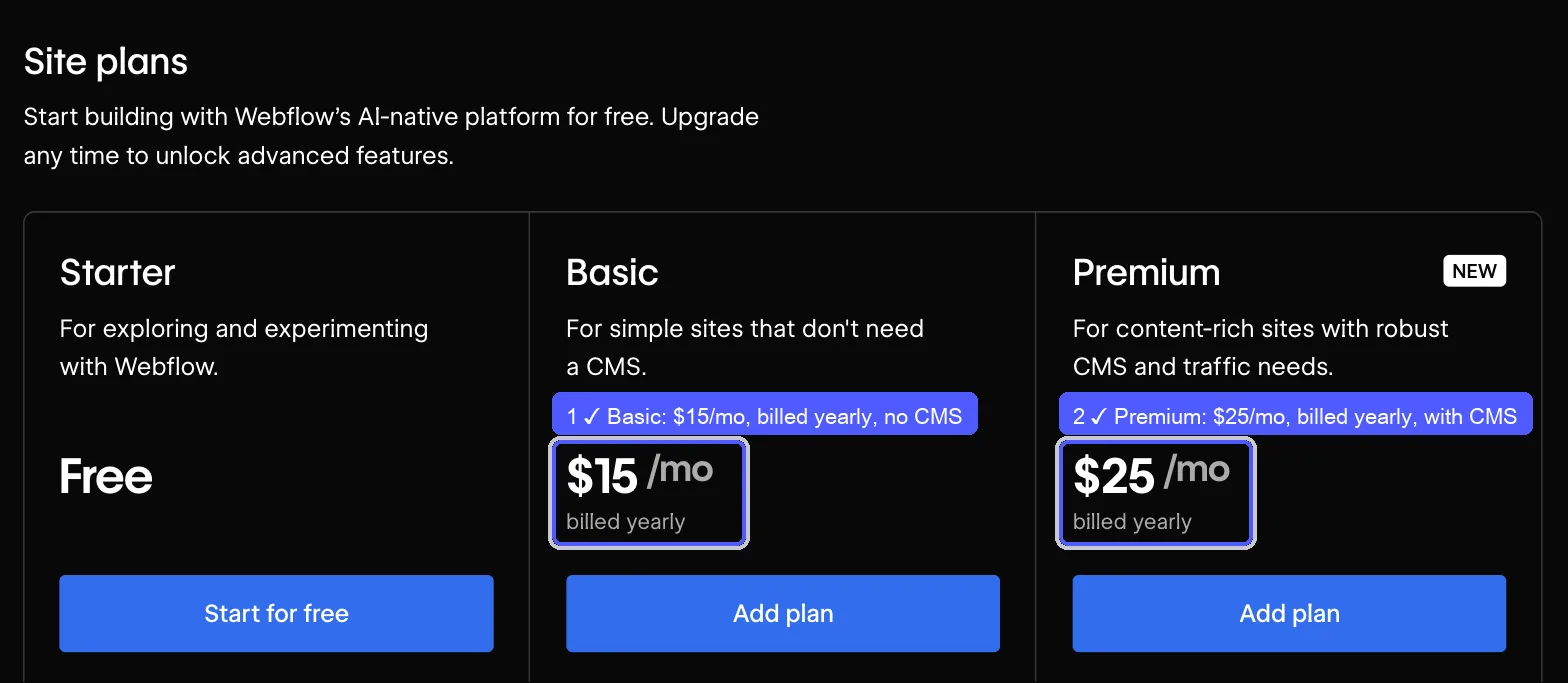
Webflow's site plans run $15/mo for Basic and $25/mo for Premium, which adds a content management system (CMS) for blogs and listings. Both are billed yearly (Webflow, October 2026).
DIY covers more platforms than Webflow. As of October 2026, Wix runs from $17/mo for Light to $159/mo for Business Elite, billed yearly. Squarespace runs from $19/mo for Basic to $99/mo for Advanced, and Shopify from $19/mo for Basic to $299/mo for Advanced, also billed yearly.
Webflow gives you more design control than most DIY builders. If you're weighing it against Wix, our Wix vs Webflow comparison covers how the two differ.
WordPress itself is free, but you pay for hosting and a theme. Elementor puts a self-built WordPress site at $100 to $300 upfront plus $10 to $50 a month.
For freelancers, a 2025 survey of 208 web designers by Web Designer Academy found 56.75% charged an average of $2,500 to $9,999 per project.
Five scope items that move the price
Page count barely moves the price of a website. These five items are what move a web design quote up or down.
Copywriting and content
Copywriting is the line web quotes most often leave out. A copywriter charges $50 to $150 an hour (Elementor), and the cost follows the writing hours. A five-page site with detailed service pages can need more writing than a ten-page site with short ones.
Most quotes assume the copy already exists, so if yours says "content provided by client", the writing is your job.
Custom design or a template
Ask which one you're buying, because the answer settles most of the price. A template is an existing design reshaped to your brand: faster, cheaper and a good fit when the template already has the pages and sections you need, so only your brand and words change.
Custom design means the layout is drawn around your content and your goals for enquiries, so it takes longer and costs more. Custom work also splits into web design and web development, planning the layout and then building it, and each part adds its own hours.
Integrations with external tools
A contact form that emails you is cheap. A form that writes each lead into your customer relationship management (CRM) system, triggers an automated follow-up and routes leads by territory costs more, because connecting tools takes more technical work to set up and test.
The same applies to a database, a payment gateway or a booking page. Each tool needs its own forms or screens designed, the connection built and the data tested end to end, so each one adds hours. The quote should name every integration it includes.
Revision rounds
Revision rounds are where budgets break, and almost no cost guide mentions them. If your quote includes two rounds and you need four, rounds three and four get billed hourly at the provider's rate. Ask how many rounds are included before you sign.
Content migration into the CMS
Moving content into the CMS is a job of its own. The CMS is where you edit the site, and before any content goes in, someone has to build templates for listings, articles, categories and empty pages.
Then the existing content moves across: the first 30 blog posts, every service page and, for a store, each product with its images, variants and descriptions.
If you're moving from WordPress, our WordPress to Webflow migration guide shows what the move involves. Our Webflow migration services can handle it for you.
Most quotes don't list migration as a line, so you find out what it costs late in the build, when the content still isn't in.
Here's how one site prices out across three providers: a six-page website for a bookkeeping firm.
| Provider | Typical price | What you get | What you still handle |
|---|---|---|---|
| DIY builder | About $180 a year (Webflow Basic, billed yearly) | Templates and hosting | Copy, structure, content entry and upkeep |
| Freelancer | About $4,000 | Design and build | Copy, content entry and post-launch upkeep |
| Agency | From about $5,000 | Strategy, design, build, copy and revisions | Reviews and feedback |
The page count is identical in all three, and the price changes with how much of the work is included.
Website cost by project type
The kind of site you need sets a second range. Elementor's 2026 cost guide puts it at about $2,000 for a brochure site and $150,000 or more for a web application.
| Project type | Typical range | Who usually builds it |
|---|---|---|
| Brochure site, 5 to 10 pages | $2,000 to $8,000 | Freelancer |
| Custom site or small online store | $5,000 to $15,000 | Freelancer |
| Small business site | $10,000 to $35,000 | Agency |
| Online store | $20,000 to $55,000+ | Agency |
| Web application | $50,000 to $150,000+ | Agency |
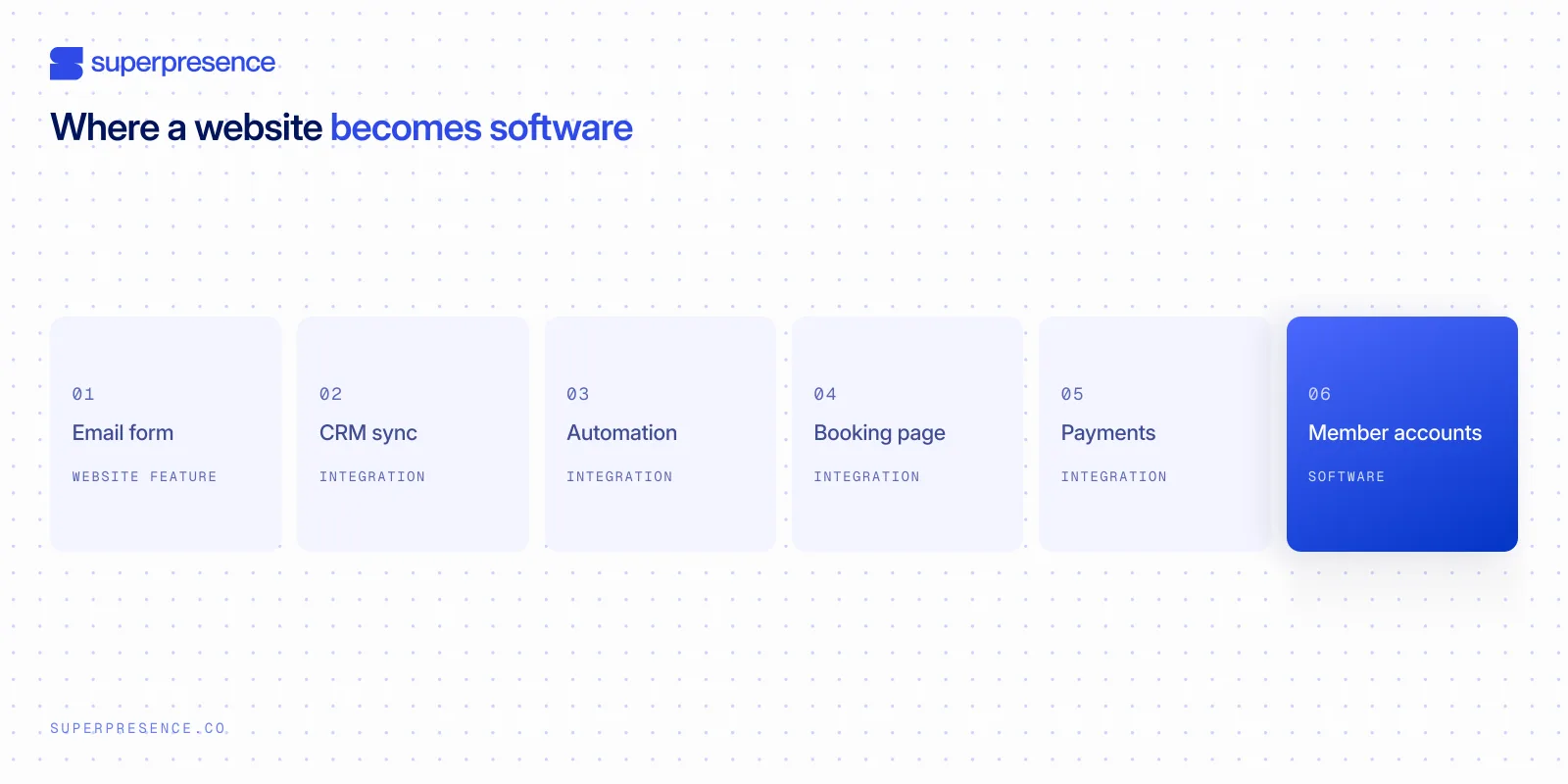
Where does a site become software? An email form is a website feature. A booking page or payments are integrations, because the site connects to a booking tool or a payment provider that handles the bookings or the money.
Member accounts are where it becomes software, because the site now stores users, logins and what each person can see.
In practice, the rows look like this:
- A clinic brochure site: five pages and an appointment form, $2,000 to $8,000.
- A professional services firm with a resource library: custom templates and gated content, $5,000 to $15,000 with a freelancer or $10,000 to $35,000 with an agency.
- An online store built by an agency: product migration and payments, $20,000 to $55,000+.
- A software as a service (SaaS) product site with gated features: you're buying an application, so budget $50,000+.
What each type of provider includes
Each type of provider sells a different share of the work, which is why their prices sit so far apart.
- DIY builder: you're the designer, writer and project manager. The plan is cheap, but your hours cost something, and Elementor's example puts 60 hours at $100 an hour at about $6,000 of your time.
- Freelancer: design and build from one person. The risk is cover, because one person means one calendar, and copy is often excluded.
- Agency: strategy, design, build and copy from a team, with someone to cover holidays and sick days. The starting price is higher, so it pays off when the site has to win enquiries and connect to other tools.
- Large agency: capacity and process for big projects with many stakeholders and fixed deadlines. Without those, you pay for structure you don't need.
On a simple brochure site, a freelancer is usually the better buy. If your site is five pages, a form and no integrations, hire a freelancer and spend the difference elsewhere.
Some providers offer a site for a flat monthly fee with no build cost. Before you sign one, ask who holds the platform account and the domain a year in.
So what would a well built business website cost? With an agency, from about $5,000, rising with the integrations and content you need. If you'd like that worked out for your own project, request a scope review through our web design services page.
How to read a web design quotation
Read the quotation for scope first, then for price. The number only means something once you know what it covers.
Seven items every quote should list
A clear quote lists each part of the job as its own line, so you can see exactly what you're paying for. Look for these seven:
- Design: how many concepts and which pages.
- Build: the platform and what's included.
- Content owner per page: a name against every page.
- Testing: devices, browsers and forms.
- Launch: who does it and when.
- Training: who on your team learns to edit the site.
- Exclusions: everything the price doesn't cover.
The exclusions line matters most, because it's where copy, content migration and post-launch support usually sit. If a quote has no exclusions section, assume everything unnamed is yours.
Fixed price or time and materials
Fixed price means the provider carries the risk of overrun, and prices that risk in. Time and materials means you pay for the hours used, so you carry the risk. The trouble starts when you don't know which one you signed and find out at round four.
Questions to ask before you sign
- Is the platform account (Wix, Webflow, WordPress host) in our name?
- Is the domain registered to us, at a registrar we control?
- Is analytics on our account, or yours?
- How many revision rounds are included, and what does round five cost?
- Who writes and enters the content, page by page?
- What happens in the first 30 days after launch, and who pays for it?
The first three are the ownership questions. Get them answered in writing, because they decide whether you can leave your provider without buying your own website back.
Quote checklist
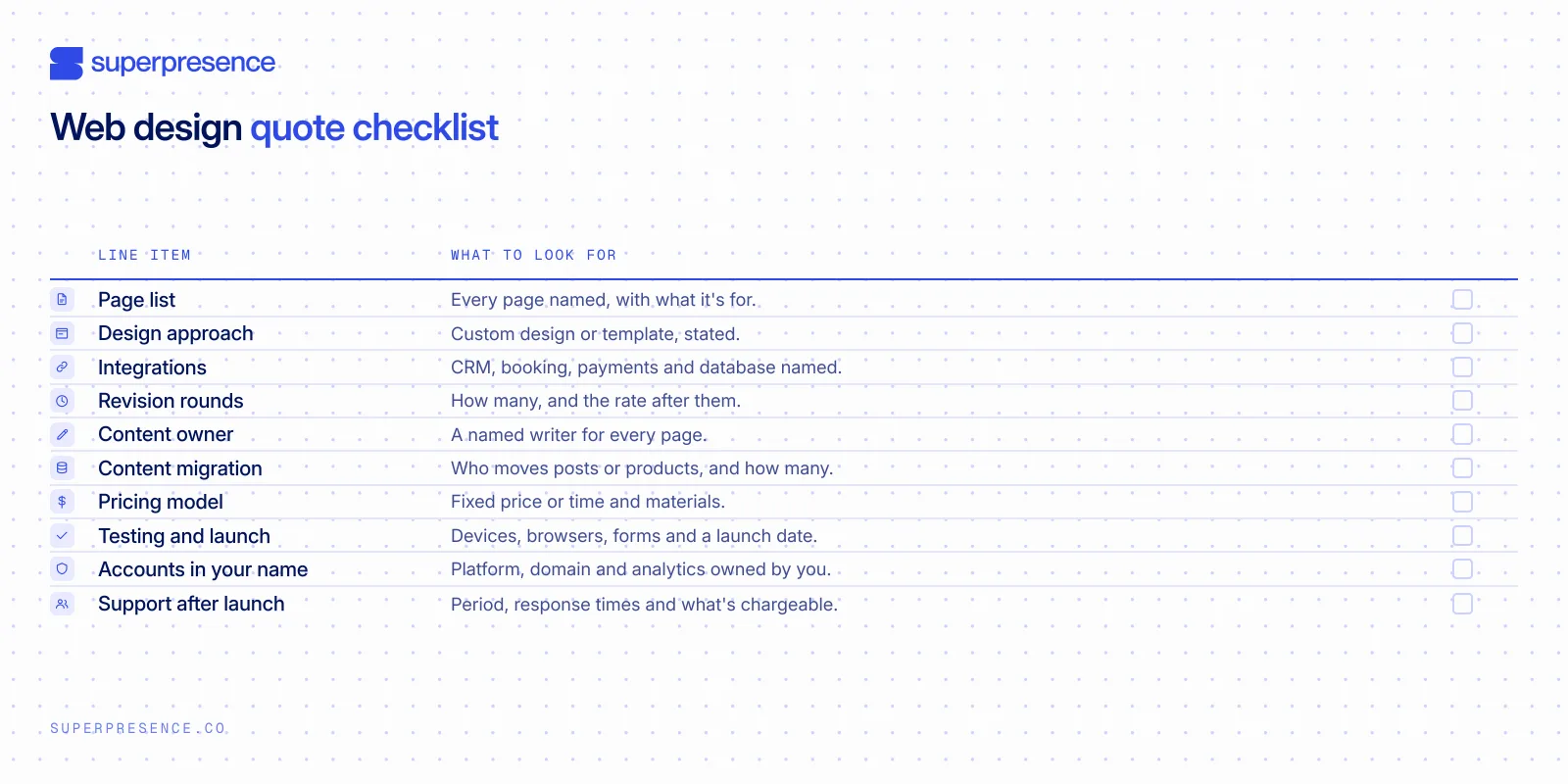
Tick what your quote states. Anything left unticked is a question to ask before you sign.
Scope
- [ ] Page list, with what each page is for
- [ ] Design approach named: custom design or template
- [ ] Every integration named (CRM, database, booking, payments, email)
- [ ] Number of revision rounds, and the rate after them
Content
- [ ] A named content owner for every page
- [ ] Who migrates posts, products or listings, and how many
- [ ] CMS templates listed (listing, article, category, empty page)
- [ ] Images: supplied, sourced or shot, and by whom
Process
- [ ] Fixed price or time and materials, stated
- [ ] Testing scope: devices, browsers, forms
- [ ] Launch date, and what happens if either side slips
Ownership and after launch
- [ ] Platform account in your name
- [ ] Domain registered to you
- [ ] Analytics on your account
- [ ] Support period, response times and what's chargeable after it
Running costs after launch
Running a site costs from about $10 a year for a domain up to $300 a month for hosting, and renewal prices are what catch people out.
| Ongoing item | Typical range | Watch for |
|---|---|---|
| Domain | $10 to $35/yr | Renewal pricing after year one |
| Hosting | $2 to $300/mo | Intro-to-renewal jumps of 276% to 307% (HostAccent's published rates) |
| Secure Sockets Layer (SSL) certificate | $0 to $100/yr | Basic certificates are free, and paid ones are rarely needed |
The advertised $2/mo is the first-term price. Renewals can jump by as much as 307% after that, so check the renewal figure before you commit to a host.
When the cheapest option is the right one
The cheapest option is right when the site is temporary, low-stakes or testing demand. A new operator checking whether a first tour sells can find out on a $17/mo Wix build.
That changes once bookings are real. Every booking through an online travel agency pays it a commission, so an established operator's own site earns its cost back in fees saved.
High-ticket operators need a premium site that matches the price of the trip, and high-volume operators need one built around conversion, where small gains in booking rate add up fast. Before you set a budget, our website ROI calculator shows what the site needs to return.
What a bigger budget buys for rankings
Price on its own doesn't move rankings, but the work a bigger budget pays for does: semantic structure, schema, a site architecture planned around what buyers search, and pages fast enough to pass Google's Core Web Vitals.
Semantic structure means headings and page code that tell Google what each part of a page is. Schema is code that labels your business, services and articles so search engines can read them.
Page experience is Google's term for how a page feels to use: how fast it loads, how quickly it responds and whether it jumps around.
Google's page experience documentation says there's no single page experience score that decides rankings. It also says good Core Web Vitals results don't guarantee top positions.
Core Web Vitals are three measurements Google publishes, each with a clear threshold:
- Largest Contentful Paint (LCP): how long the main content takes to load. Good is 2.5 seconds or under.
- Interaction to Next Paint (INP): how quickly the page responds when someone taps or clicks. Good is 200 milliseconds or under.
- Cumulative Layout Shift (CLS): how much the layout jumps while it loads. Good is 0.1 or under.
A cheap template can pass the speed thresholds, but it won't come with an architecture planned around your keywords or schema on every template. Those need someone to plan and build them, which is what SEO web design covers, so they belong in the quote as named line items.
The first build is also where the SEO basics get set: redirects from old URLs, indexing settings and which search each page targets. Getting them right in the first build costs less than fixing them after the pages are live.
Some cost guides still cite First Input Delay (FID), which INP replaced as a Core Web Vital in 2024. If a provider's performance pitch leans on FID, their information is out of date.
Read the scope before the price
Two quotes for the same site can sit thousands of dollars apart and both be fair. One includes copy, migration and SEO structure, while the other leaves them to you.
Comparing the totals won't tell you which is the better buy. Line the quotes up item by item and mark what each one leaves out. Then price those gaps in your own hours or with another provider, so you're comparing the same job.
Send us your scope and we'll tell you which type of provider it needs and what it should include. You get an itemised scope back, free: request a scope review.
Frequently asked questions
Can I move my site to another platform later?
Sometimes, and it depends on the platform. Moving between hosted builders often means a rebuild, because templates and content structures don't transfer cleanly. If moving later is a real possibility, ask for the platform account in your name before you sign, and ask the provider how the content can be exported.
How long does a website take to build?
A simple brochure site takes a few weeks. Business sites with a CMS, online stores and web applications take longer, and content volume and integrations set how much longer.
Late copy and extra revision rounds cause most delays. Our web design process piece walks through the timeline stage by stage.
Do I need a designer and a developer?
For a template-based site, one person can usually handle both. Custom design with complex integrations needs both skills, and often two people. Most business sites sit somewhere between the two, so ask which parts of your build each person covers before you hire anyone.
Is an AI builder good enough for my site?
For a low-stakes site or a demand test, often yes. For a business site that has to win enquiries, AI builders still fall short on strategy, copy and the scope items above. Our piece on whether AI can build your website covers where they hold up.



![Portrait of a Kevin D Chen [Dark]](https://cdn.prod.website-files.com/6963b46b73d13c416619d604/696770db31b454394fd4709a_43e4f0a4b187c1f51dd5024dd9980a60_kevin-photo.avif)