Can AI build your website? Yes. That's exactly the problem

Every few weeks a prospect asks me some version of the same question: can't AI just build this now? My honest answer tends to surprise them. Yes, it can, and the output can be decent, especially if you know what you’re doing.
We use AI every day inside our own work, so I know where its limits sit. It's trained on everything that already exists, which means it pulls every output toward the middle. That's fine for most jobs, but a real problem for any business trying to stand out.
Let’s be honest about what AI can actually do
Yes, AI can build your website. If you prompt AI engines like GPT, Claude, or a specialised AI website generator, you’ll get a fully functioning website in less than five minutes.
For an early-stage project that just needs a digital placeholder to show it exists, using AI can be the right solution. But trying to "one-shot" a final, premium website straight out of a generator isn't how you actually use AI.
Where AI excels in web design, is in speeding up existing design processes and workflows. Instead of doing the entire process, it can handle parts of the repetitive process. AI models are great for:
- Exploring variations: Generating dozens of different layouts in seconds to test structural ideas
- Drafting fast copy: Producing rapid text options to establish baseline messaging
- Mocking up directions: Visualizing raw design paths you might not have considered
This gets a senior team to a strong starting point in minutes instead of hours. It cuts out the tedious work and speeds up ideation, freeing them up to focus on the heavy judgment and creative processes that a prompt simply can’t replicate.
AI output is average by design
Since AI is trained on everything, there’s a certain pattern when teams generate sites this way. The hero layouts converge and the section order repeats. You end up with a page that looks acceptable and says nothing distinct about you.
I'd call it pretty-but-generic. The page clears the bar for "looks like a real company" and fails the only test that matters for a leader, which is looking like your brand and no one else. A category leader's whole job is to be the deliberate exception.
Better models don't close this gap. They raise the floor for everyone. And as the floor rises, what it takes to look genuinely distinct rises with it.
Generic AI sites waste your ad spend
If you spend on ads, your return lives on the landing page. Send paid traffic to a generic page and you're paying for clicks that won't convert. You can't outperform the market on a page that looks like the market.
Ad spend only buys clicks. Pipeline gets made on the page itself, depending on how well it's shaped for your specific buyer and how clearly it stacks proof.
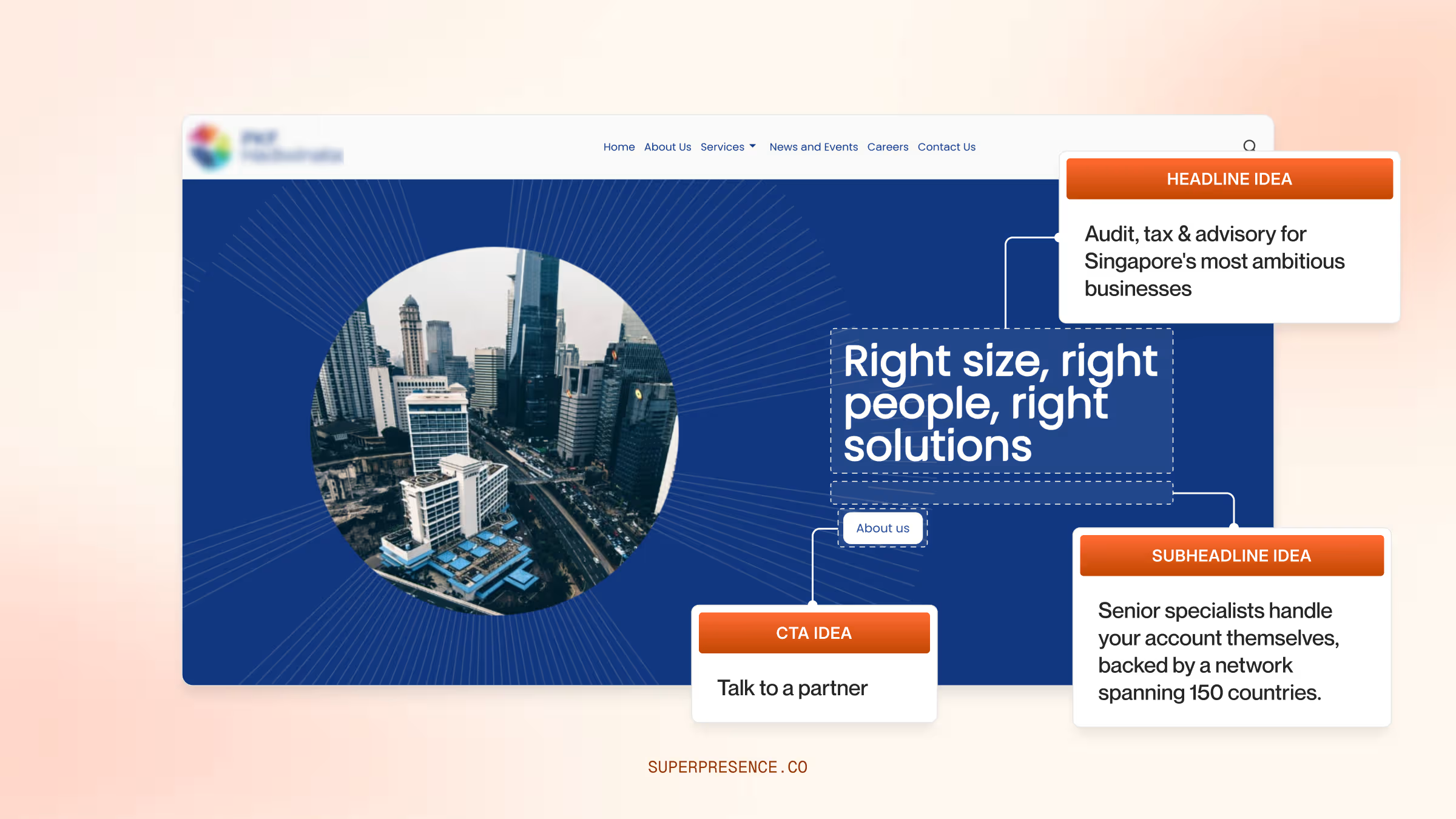
AI helps because it can diagnose a weak page and suggest angles, which is genuinely useful inside the loop. What it can't do yet is craft the page for this company's specific ICPs, aligning the visuals and the message to one real buyer.
If AI could do that last mile, we'd be thrilled, because we'd need fewer experts and get more done. It just isn't true yet.
Buyers can tell when AI built your site
There's a cost to a generic site you won't see in your analytics. When a serious buyer can tell your website is AI-generated, they quietly start asking what else you cut corners on.
And before a single conversation, your website has already answered the question they care about most: how do these people actually work?
Buyers of high-stakes purchases read every signal for risk, and the website is usually the first proof of your standards they ever see. They rarely name it as "AI." They feel the sameness, and felt sameness reads as low standards.
"If they outsourced their own face to a generator and didn't sweat the details there, what happens when they're handling my account and my money?"
That logic runs mostly unconscious, and it bites hardest where the stakes and the price are highest: premium positioning and long B2B sales cycles. The buyers you most want to win are the ones most fluent in reading the signal.
The inverse is the part worth paying for. A site built with real craft does persuasive work before the sales call ever happens, signalling care and standards while you sleep.
When using AI is the right call
Sometimes AI or a template is genuinely the right call, and I'll say so plainly. If the job is basic, fast, low-stakes, and budget is the real constraint, don't hire us. Stakes decide that call.
My suggestion is to reach for AI or a template when these hold:
- Basic scope: You need a few pages that look legit, nothing more
- Fast turnaround: The site has to exist this week, not be the best in its category
- Low stakes: It isn't carrying paid traffic or a category-defining bet
- Tight budget: Cost is the genuine constraint, and you'd rather spend it elsewhere
None of this is new. Templates existed long before AI and never replaced designers. They competed at the low end and left the top alone, and AI is the same dynamic with more power.
The one real difference is the direction of travel. Templates were static, AI keeps improving, but the bar for category-defining keeps rising in step. Winning at the low end has always been a different game from leading a category.
A designer’s judgment can’t be prompted
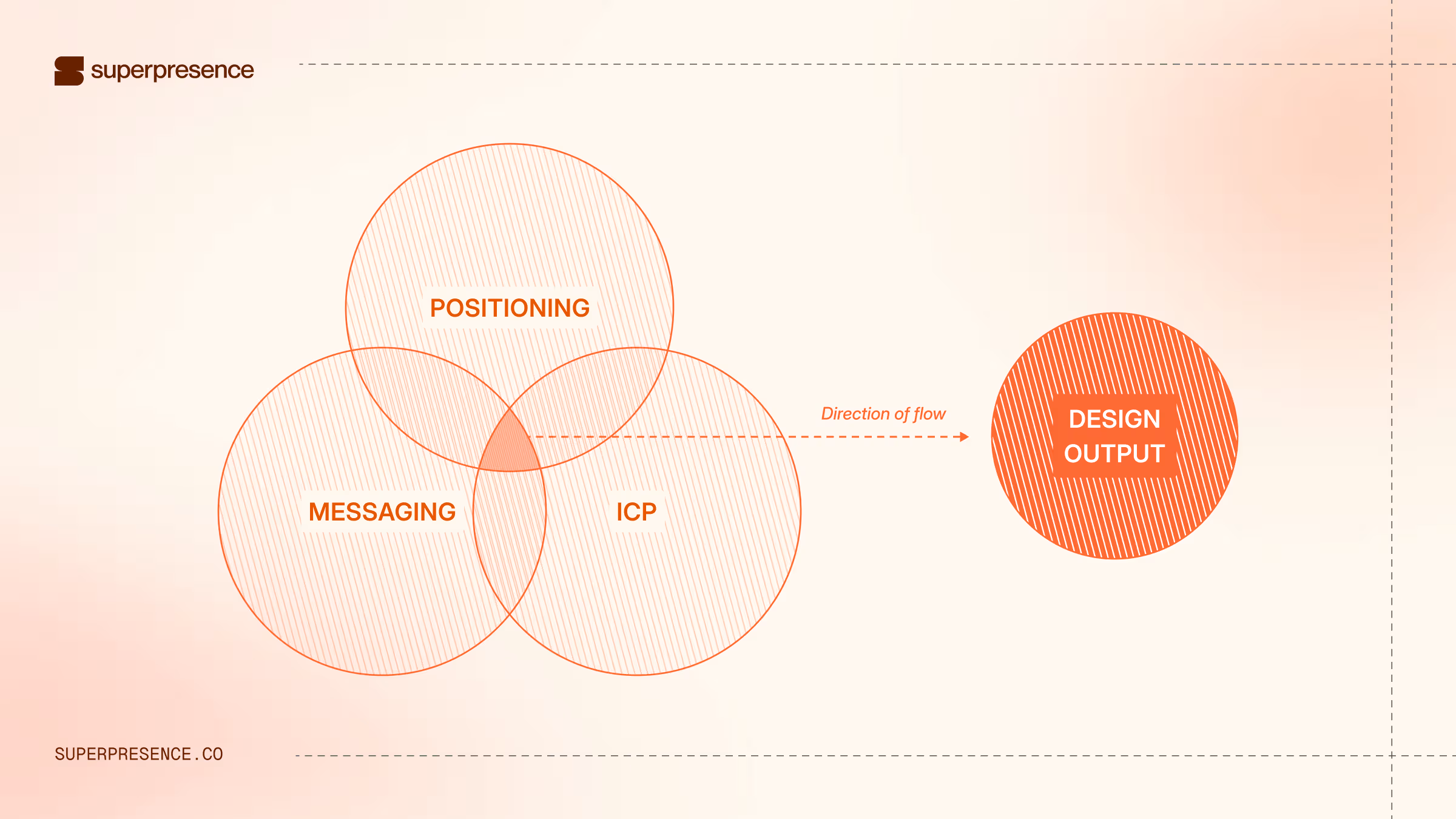
AI generates outputs, but it doesn't decide what to say or who to say it to. Positioning, what to emphasize, what to leave out, and that's where most of the value is.
We call it strategy-led design to help sharpen clarity. It can't create it, so the thinking has to be right before a single section gets built.
Every visitor, human or AI, is trying to extract three things from your site: what you do, how you do it, and your track record. Getting those clear is judgment work, and judgment is the thing a prompt can't supply.
A pretty page that doesn't convert isn't an asset. A good designer ties every choice back to your funnel and revenue. AI has no stake in your results, and it'll hand you a beautiful page without caring whether it earns a single lead.
Final thoughts
The real question was never whether AI can build a website, it clearly can. The harder question is what being first-rate is actually worth to your business. Because a tool trained on the average of the internet will only ever give you an average website.
If your business wins by being interchangeable, the average is fine. If it wins by being the obvious choice on a crowded shortlist, sameness is the one thing you can't afford. That's exactly what a tool trained on everything is built to produce.
If you're looking to build an asset that stands completely apart from the flood of generic, AI-generated sites, let’s connect or request a website review. A quick evaluation will reveal exactly where a templated layout is costing you enquiries.
FAQ
When should I just use AI or a template instead of hiring anyone?
When the job is basic, fast, low-stakes, and budget-constrained. If you need to look legit quickly and the site isn't carrying paid traffic or category ambition, AI or a template is the rational call, and we'll tell you so plainly.
Isn't this just an agency protecting its own business from AI?
We use AI on every project. For the right tasks, we'd use it for more. The argument isn't against AI, it's about where it stops being useful. A tool that pulls toward the middle is the right call for a lot of work. It's the wrong call when the whole job is to look nothing like the middle.
If AI is so limited, why do you use it every day?
Because it's genuinely strong at drafts, research, variation, and iteration. It belongs inside the workflow as an accelerant, where it speeds up good operators. What it doesn't supply is the point of view or the commercial stake in your results.
Won't AI close this gap as the models get better?
Better models raise the floor. They don't change the pull toward the mean, and the bar for category-defining rises right alongside that floor. AI relocates the gap between competent and remarkable rather than closing it.
.avif)
![Portrait of a Kevin D Chen [Dark]](https://cdn.prod.website-files.com/6963b46b73d13c416619d604/696770db31b454394fd4709a_43e4f0a4b187c1f51dd5024dd9980a60_kevin-photo.avif)