





Key takeaways
- Website maintenance in Australia costs about AUD 70 to 200 a month on published care plans (November 2026), before domain and platform fees.
- Platform fees run from about AUD 60 a year for a self-managed server to about AUD 500 for Shopify Basic.
- WordPress needs the most update work, because 91% of new WordPress vulnerabilities in 2025 were in plugins.
- On a self-managed server you patch the operating system, and a custom-coded site needs a developer for every package update.
- The Australian Taxation Office (ATO) lets you deduct maintenance in the year you pay it and treats a rebuild as a capital expense.
Website maintenance cost in Australia runs from about AUD 70 to 200 a month on published care plans, before the domain and the platform your site runs on. That platform sets most of the maintenance bill, because it decides who applies updates.
Maintenance means the updates, fixes and content changes that keep a live site secure and working, which is what website maintenance services cover. A Shopify store and a WordPress site with many plugins need different plans. Budgeting by platform stops you paying for hours you don’t need, or skipping ones you do.
Website maintenance cost in Australia: the fixed fees
The fixed fees run from about AUD 60 to about AUD 500 a year, plus a domain. The domain costs about the same for every site, and the platform fee depends on what the site is built on.
A .com.au costs about AUD 20 to 33 a year from accredited registrars and their resellers. First-year deals start from about AUD 10, and renewals go back to the standard price.
All prices are in AUD. Prices from overseas platforms are converted at the Reserve Bank rate on 9 November 2026 and exclude tax.
| Platform | What the yearly fee covers | Typical AUD a year |
|---|---|---|
| WordPress on Australian shared hosting | Server space and the environment WordPress runs in | About AUD 190 to 310, plus about AUD 70 to 170 for each paid plugin |
| Webflow | Hosting and the builder. Basic has no content management system (CMS), and Premium adds the CMS your team edits in | About AUD 260 (Basic) to 435 (Premium) |
| Shopify | Hosting, checkout and the shop admin | AUD 504 on Basic, billed yearly |
| Custom code on a managed host | Hosting on Vercel Pro or Netlify Pro, charged per developer seat, or on Cloudflare's cheaper paid plan | About AUD 350 per seat, or from about AUD 87 on Cloudflare |
| Custom code on a self-managed server | An Australian virtual private server (VPS), with the operating system left to you | About AUD 60 to 160 |
A custom-coded site whose team edits content itself adds a headless CMS, from about AUD 260 a year per seat. Prices are each company’s listed price on 9 November 2026, and the Australian hosts’ figures are standard prices with first-year deals left out.
Most hosts, every hosted builder and the managed hosts include the Secure Sockets Layer (SSL) certificate. If your invoice shows a separate SSL fee, ask what it pays for.
Sidenote:
Overseas platforms add tax at checkout. Goods and services tax (GST) has applied to imported digital services sold to Australian consumers since 1 July 2017, and software maintenance is one of the named categories, so the invoice differs slightly from the converted price.
None of these fees cover the build, which is a separate, one-off website cost paid before launch.
Why the platform decides most of the bill
The update work, and who pays for it, depends on the platform. Content changes cost about the same on any platform.
- WordPress: You pay for the most update hours. The core, the theme and every plugin get updated separately, and 91% of the 11,334 new WordPress flaws Patchstack logged in 2025 were in plugins. Someone has to apply each update and check the site still works.
- Webflow and Shopify: You pay for the fewest update hours. Each company updates its own platform and hosting, so the hours you buy go to content and fixes.
- Custom code on a managed host: You pay a developer for every update. Vercel, Netlify and Cloudflare update their servers, but the site uses ready-made code packages needing security updates. Every one to two years, its base software, such as Next.js, stops getting fixes, and moving to the new version is a bigger paid job.
- Custom code on a self-managed server: It has the cheapest yearly fee and the most update hours. On top of everything custom code needs, you or a developer you pay has to update the server’s own operating system.
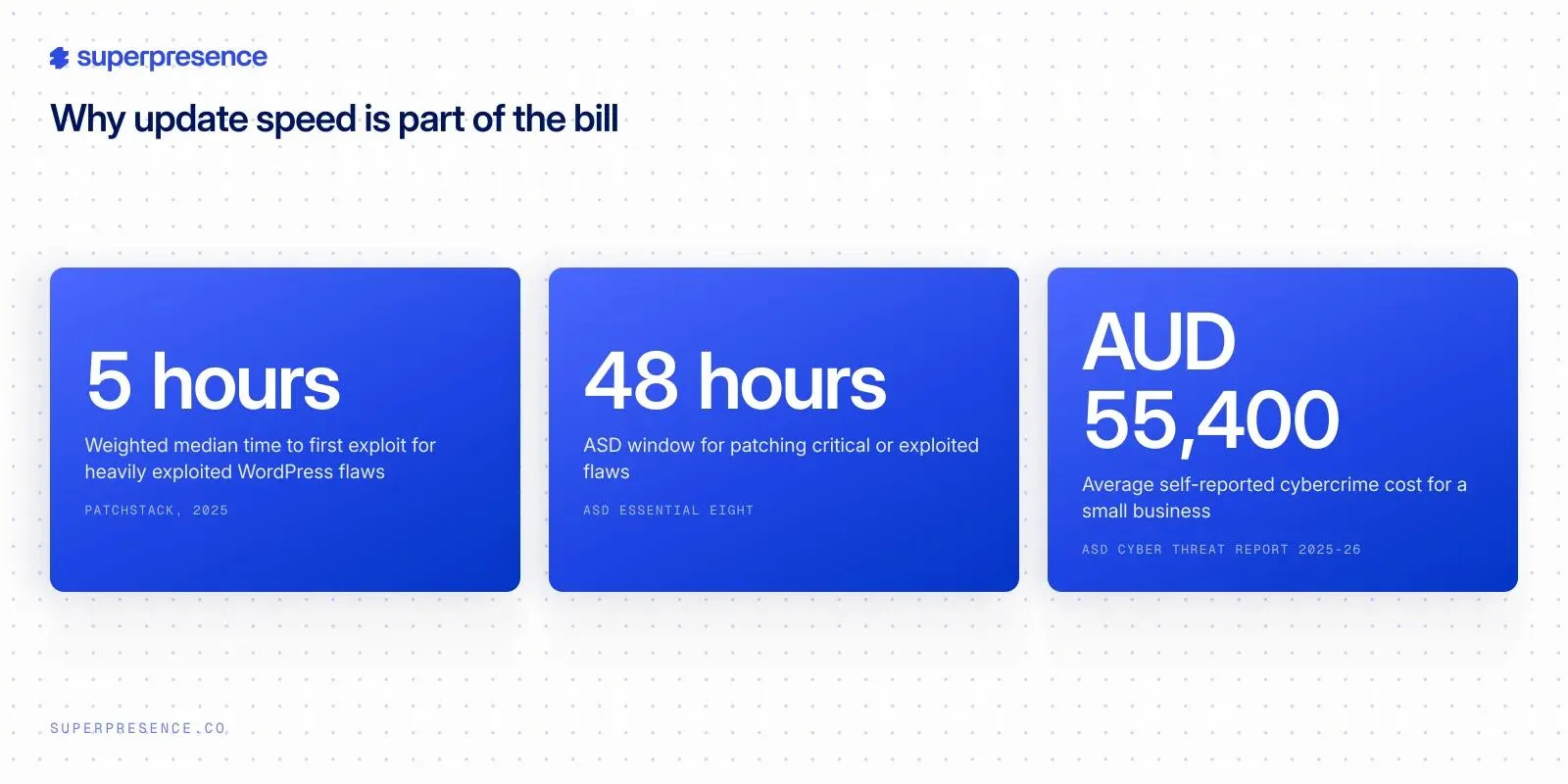
Of those 11,334 WordPress flaws, 46% weren’t fixed in time for public disclosure, and heavily exploited flaws had a weighted median of 5 hours to first exploit. If no one can test your updates the week they’re released, buy a plan with update testing or move the site to a hosted builder.
We build on hosted builders such as Webflow and Framer, because the team that runs the site can edit it without paying for update hours. A builder stops fitting when the site needs workflows it can’t run, and custom code only costs less to run when a developer is already on hand.
How many hours does a business site need?
A care plan from an Australian agency or freelancer buys roughly 1 to 3 hours of work a month. In November 2026, care plans cost about AUD 70 to 200 a month, at published rates of about AUD 70 to 150 an hour.
Hosted builders need the fewest update hours. WordPress with a plugin stack, custom-coded sites and self-managed servers all need more. The hours go on:
- Updates and testing: applying them, then checking nothing broke
- Fixes: broken layouts, failed form submissions, plugin conflicts
- Content changes: new pages, staff changes, price updates
- Checks after each change: forms, speed and mobile rendering
- Accessibility checks: on new content as it goes up
For a custom-coded site, budget a framework and Node.js upgrade every one to two years as a one-off project outside the monthly hours.
To set your own labour line, multiply the hours by your agency or freelancer’s hourly rate. Ask each one how many hours a plan includes, since some plans count tasks instead of hours.
Whoever you hire, ask for three things in writing: an estimate before any hours are used, a monthly record of the hours spent, and a list of what the plan excludes. Without them, you can’t tell how much work a fixed fee buys each month.
Our website maintenance plans come in blocks of 2 to 4, 6 to 10 or 15 to 25 hours a month. We estimate each request first, and a one-page monthly report shows the work shipped, hours used and one recommendation. Hosting, the domain and redesigns sit outside the plan.
An in-house developer costs AUD 85,000 to 105,000 a year in salary, according to SEEK in November 2026, before on-costs. You can do some of the work yourself for free: blog posts, product and price updates, and a check of your forms after every change.
Before you switch agency or freelancer, run a website handover checklist. The domain, hosting and site accounts should be registered to an email your business controls, because a login doesn’t transfer ownership of the account.
Australian rules your maintenance has to cover
Four Australian rules and guidelines decide part of what maintenance must cover, and none of them depends on how big the site is.
Domain eligibility
A .com.au licence needs an Australian commercial entity, such as a company or a business with an Australian Business Number (ABN). You must stay eligible for the whole licence period, and if you don’t, the licence may be suspended or cancelled.
Licences run 1 to 5 years, and each renewal is also an eligibility check.
Important:
If you restructure, deregister a company or cancel an ABN, move the domain to the new entity first. A deregistered company's licence is deemed cancelled 30 days after it ceases to exist.
Patching timeframes
The Essential Eight maturity model from the Australian Signals Directorate (ASD) is guidance for organisations’ systems in general, and a business website is one of them.
It says patches for critical vulnerabilities, or ones with working exploits, should be applied within 48 hours of release, and other patches within two weeks when no working exploit exists.
The same guidance says online services that vendors no longer support should be removed, which is why an end-of-life Node.js or framework version matters for a custom-coded site.
ASD reports that it keeps seeing incidents caused by unpatched vulnerabilities, including the exploitation of a flaw first identified in 2008. Its Annual Cyber Threat Report for 2025 to 2026 puts the average self-reported cost of a cybercrime report from a small business at AUD 55,400.
Privacy duties
The Privacy Act exempts most businesses with annual turnover of AUD 3 million or less, but it covers health service providers regardless of turnover.
If you run a clinic that takes bookings through a form, your maintenance has to cover patient data. That means checking who can access submissions, where they’re stored, and how the form says details are used.
Accessibility guidance
The Australian Human Rights Commission (AHRC) says organisations should conform with Web Content Accessibility Guidelines (WCAG) 2.2 at a minimum of Level AA. The Disability Discrimination Act requires providers of goods and services not to discriminate against people with disability.
New pages need checking as they’re added.
Maintenance or rebuild: how the ATO sees it
The ATO lists site maintenance that preserves the site’s character as an operating expense. You claim it as a deduction in the year you incur it.
Acquiring or developing a site is a capital expense, which you generally claim over time. Software subscription fees sit with the operating expenses.
Fixing, updating and refining the site you have counts as maintenance. New templates, functionality or structure count as development, which is priced like website design packages in Australia.
If you’re registered for GST and claim the full credit, you exclude the GST amount from the deduction. Confirm borderline items with your accountant before you claim them.
Budget for the hours your platform needs
Set the budget from the platform first, then add the duties your business carries. The domain and the platform fee are small and predictable, and budgets go wrong on the hours.
A low platform fee with heavy update work can cost more over a year than a higher fee on a platform that patches itself.
| Your site | What to pay for | What your team can edit itself |
|---|---|---|
| Webflow | A small monthly plan for fixes and checks | Blog posts, CMS items such as team or case studies, text and images on existing pages |
| Shopify | A small monthly plan for fixes and checks | Products, prices, stock, blog posts, and page sections in the theme editor |
| WordPress with many plugins | A care plan that tests each update, or a move to a hosted builder | Posts and pages |
| Custom code on Vercel, Netlify or Cloudflare | A developer for package updates and version upgrades | Only the fields the developer set up in the CMS, such as blog posts |
| Custom code on your own server | A developer for packages, upgrades and operating system updates | Only the fields the developer set up in the CMS, such as blog posts |
Before you set a number, check how far behind your own site’s updates are. Book a free website review and we’ll tell you what your site needs each month and why.
FAQ
How often does a website need maintenance?
Apply updates as they’re released, and fast when a flaw is critical or already being exploited, if you follow ASD’s guidance. Check forms, speed and mobile rendering every month. Make content changes as the business changes, and run accessibility checks whenever new content goes up.
Can I maintain my website myself?
On a hosted builder you can publish blog posts, update products and change text and photos, but new layouts usually need a designer. WordPress updates need testing on a copy of the site first. A self-managed server needs someone who can patch an operating system, and custom code needs a developer for package updates.
Is website maintenance tax deductible in Australia?
Yes, maintenance such as updates and fixes is an operating expense you deduct in the year you pay it. Once the work adds new templates or functionality, it counts as development and the deduction is spread across later years, so check borderline cases with your accountant.
How much does it cost to keep a website running each year in Australia?
Add the domain and your platform’s yearly fee, then put labour on top. A hosted builder needs the fewest hours. A WordPress site with many plugins, a custom-coded site or a self-managed server needs more, so price the hours before you choose a plan.
Written by

From Sydney, Australia with a decade in Asia, Kevin built his expertise driving product and growth at tech startups across fintech, logistics, consumer apps, and crypto. He founded SuperPresence with this expertise and passion, helping businesses create high-converting web experiences and digital growth strategies that drive real revenue impact.
Share this article