




Key takeaways
- The best hotel sites in Thailand show room facts, travel details and a reason to book direct before a guest has to ask.
- Put a booking bar with dates and guests at the top of the homepage, as Samujana Villas and Six Senses Samui do.
- Give each room its size, guest limit and view before the rate, as Six Senses Samui and The Siam do.
- Show awards with their years and reviews with their source, as The Nai Harn and sala rattanakosin do.
- Write out what booking direct gets and place it by the booking button, as sala rattanakosin does with best rates, discounts and late checkout.
When guests plan a trip, they compare hotels online and pick the one they want to stay at. Then they pick where to book it: on an online travel agency, or on the hotel’s own website, where the booking pays no commission to the travel agency.
A good hotel website wins the guest at both points.
These hotel website design examples in Thailand were picked on how well each site does that: what the hotel is and where, room facts, proof from other guests, travel details and a reason to book direct. You can use this list as references to brief a hotel web design agency for a redesign.
Why does a hotel need its own website?
A booking on your own site pays no commission to an online travel agency. You also decide what your guests see there: the book-direct offer, every room’s full details and how to get to you.
Online travel agencies still bring guests who don’t know you yet, so keep listing there. Your site’s job is to give those guests a reason to finish the booking with you.
What should a hotel website have?
A hotel website needs seven things, and each one answers a guest’s question before they email you. These are the questions your website should answer for a hotel:
- Booking engine: live rates and availability, takes the booking and payment on your own site.
- Booking bar on the first screen: check-in, check-out, guests, and a button that shows prices.
- Room pages: photos, size, beds, maximum guests, view, starting rate.
- Book-direct offer: what a guest gets only on your site, next to the booking button.
- Reviews and awards: named, with years and sources.
- Location and getting here: airport drive time, transfers, nearest pier or station.
- Mobile layout: fast on a phone, booking button always in reach.
What makes a hotel website stand out?
A hotel website stands out when it does two jobs. It makes guests choose your hotel over the others they’re comparing, and it gets them to book on your site instead of going back to an online travel agency.
It makes guests choose your hotel
Four things answer what guests check when they compare hotels:
- A headline that says what and where: the type of hotel and the town or island in the headline, so a guest knows at once they’re on the right site.
- Room facts before the rate: size, beds, maximum guests and view on every room, the questions your guests would otherwise email to ask.
- Proof a guest can check: awards with their year and reviews with their source.
- Travel details with numbers: drive times, transfer prices and walking distances, so guests can plan the trip from your site.
It gets guests to book direct
Once a guest has picked your hotel, they can still book it on a listing site. Three things bring that booking to you:
- A booking bar at the top of the homepage: dates and guests, with live prices one tap away.
- A stated reason to book direct: the best rate, a discount, late checkout or a free extra, written out.
- That reason next to the booking button: when it’s only on an offers page, a guest who books from a room page misses it.
The eight examples below were picked on these seven points, the same checks our web design services team uses on hotel sites.
The 8 best hotel website design examples in Thailand (2027)
1. Samujana Villas, Koh Samui
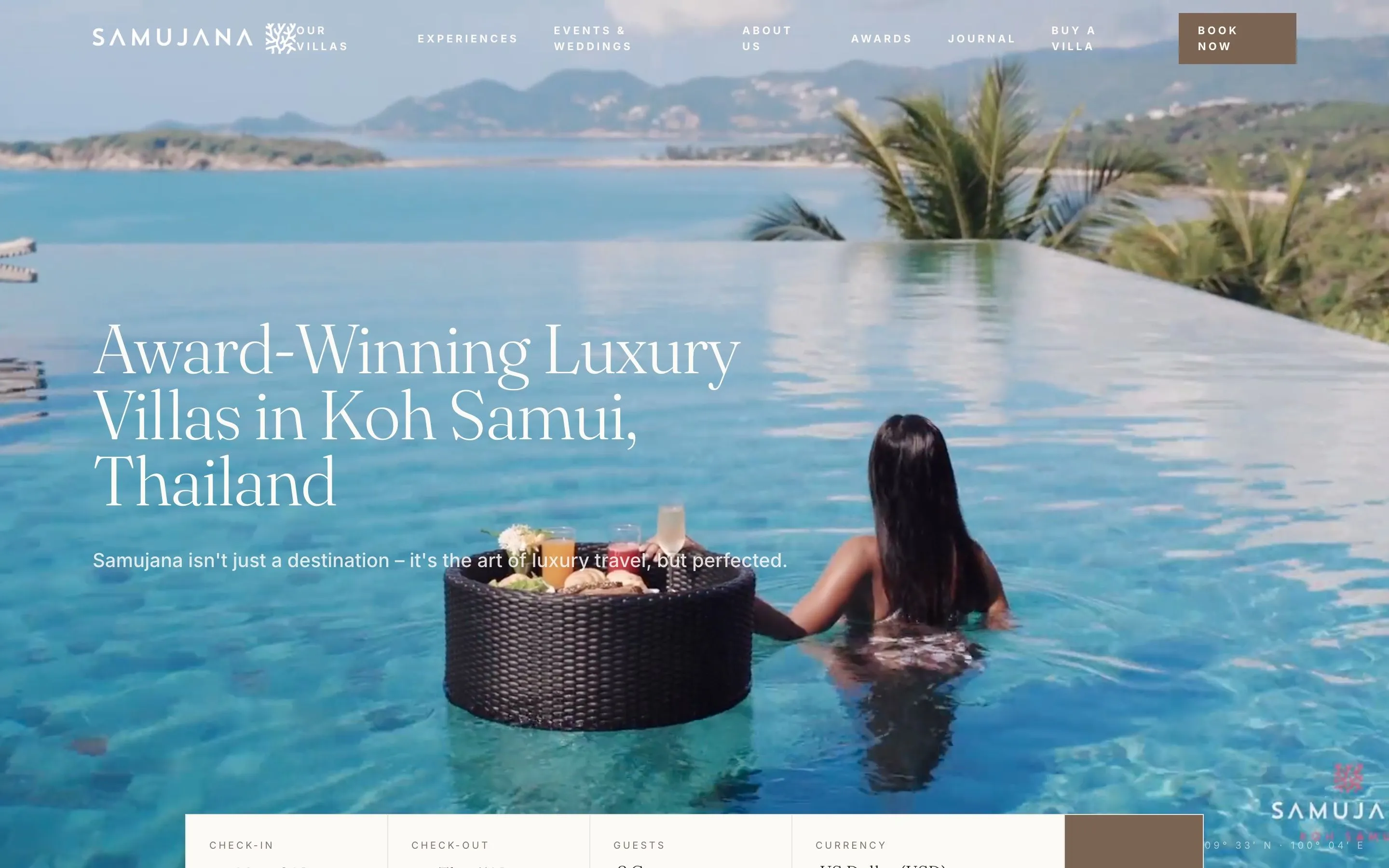
Samujana's headline names the villas and the island, and the booking bar takes up to 16 guests.
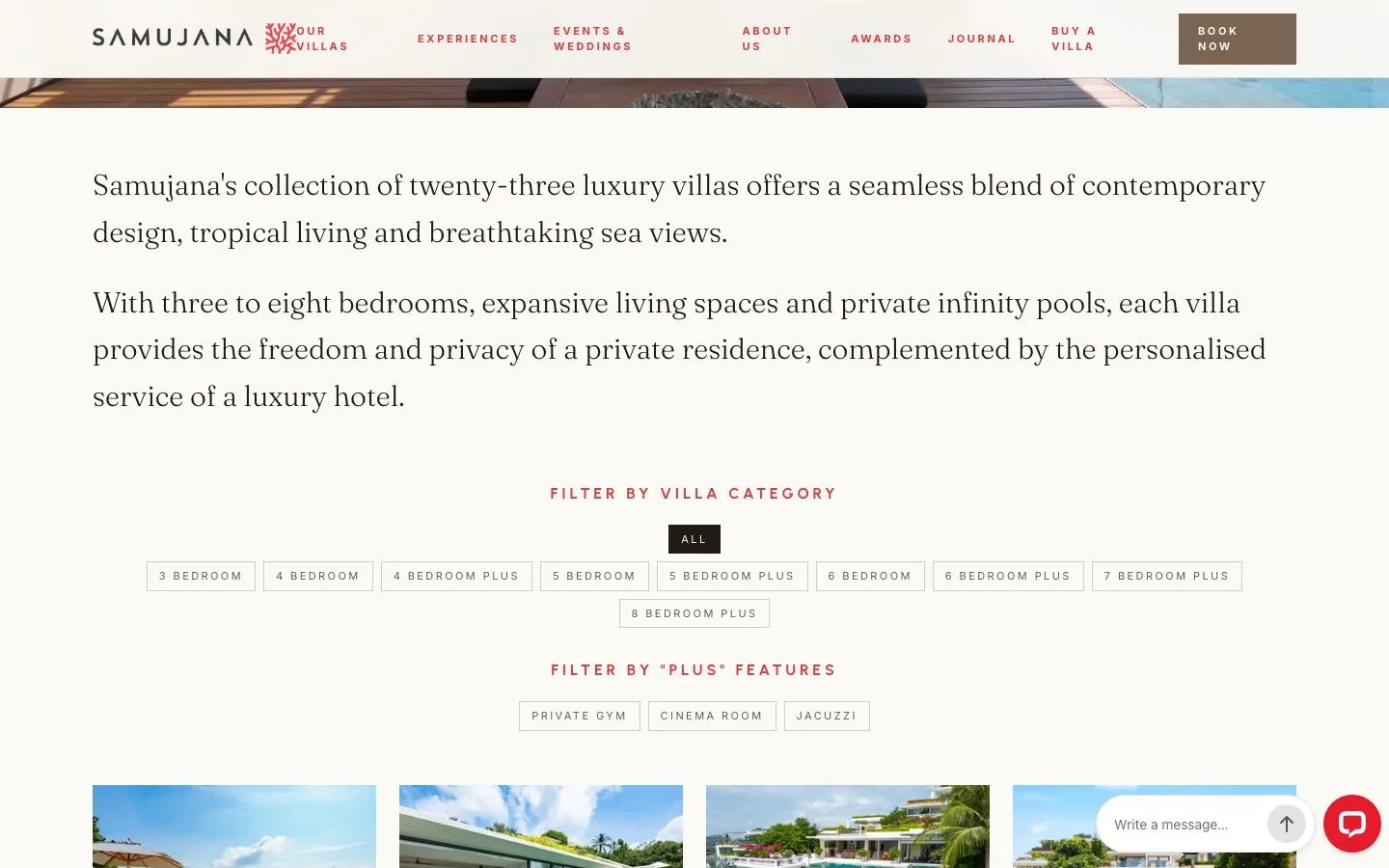
Groups shortlist Samujana's villas by type and features before opening a single villa page.
Website: samujana.com
Hotel overview: Samujana is a collection of 23 private villas on a hillside on the north-eastern coast of Koh Samui, about ten minutes from Samui International Airport. Each villa has three to eight bedrooms and a private infinity pool, so it suits families, friends and colleagues travelling together. Every stay comes with a dedicated Villa Manager.
The property also hosts weddings, with guest counts from 2 to 250 depending on the venue. It holds a Condé Nast Johansens 2026 Readers’ Award, and its villas were the 2025 filming location for season three of HBO’s The White Lotus.
Why their website works:
- Headline naming the product and the island: “Award-Winning Luxury Villas in Koh Samui, Thailand”. A guest arriving from an online travel agency or a search result knows at once they’re on the right site.
- Booking bar with a guest field up to 16: dates and a guest count for the whole party on the first screen. A group organiser checks availability for everyone without sending an enquiry form.
- Currency menu in the booking bar: 12 currencies including THB, EUR, GBP, AUD and SGD, so overseas guests see the cost in their own money before checking prices.
- Villa filters by category and extras: private gym, cinema room, jacuzzi. A group with fixed needs shortlists from 23 villas without opening each page.
If you run villas or multi-bedroom units, a guest field that goes up to 16 lets one person book for the whole party.
2. Six Senses Samui, Koh Samui
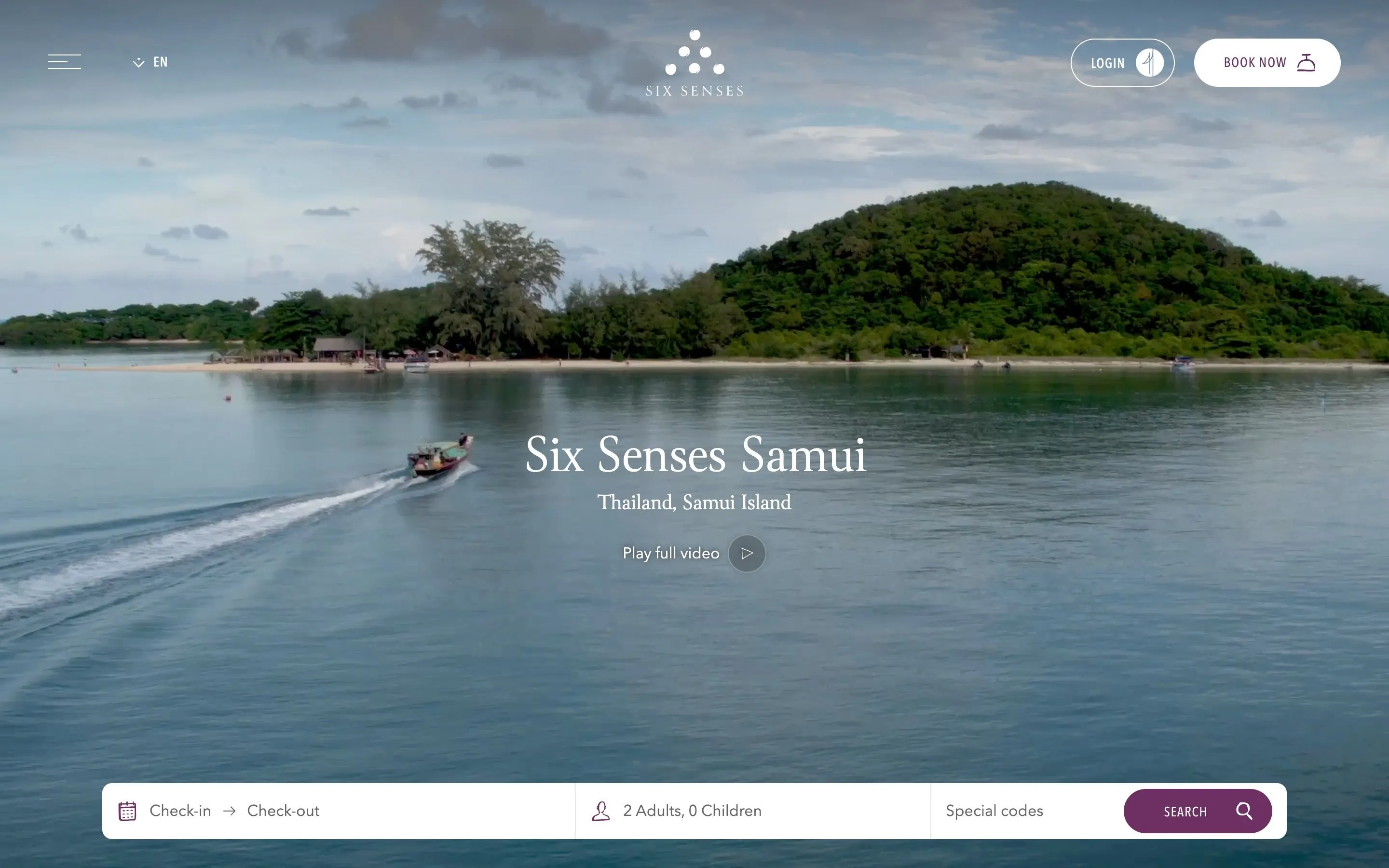
Six Senses Samui puts dates, guests and a search button over its hero video.
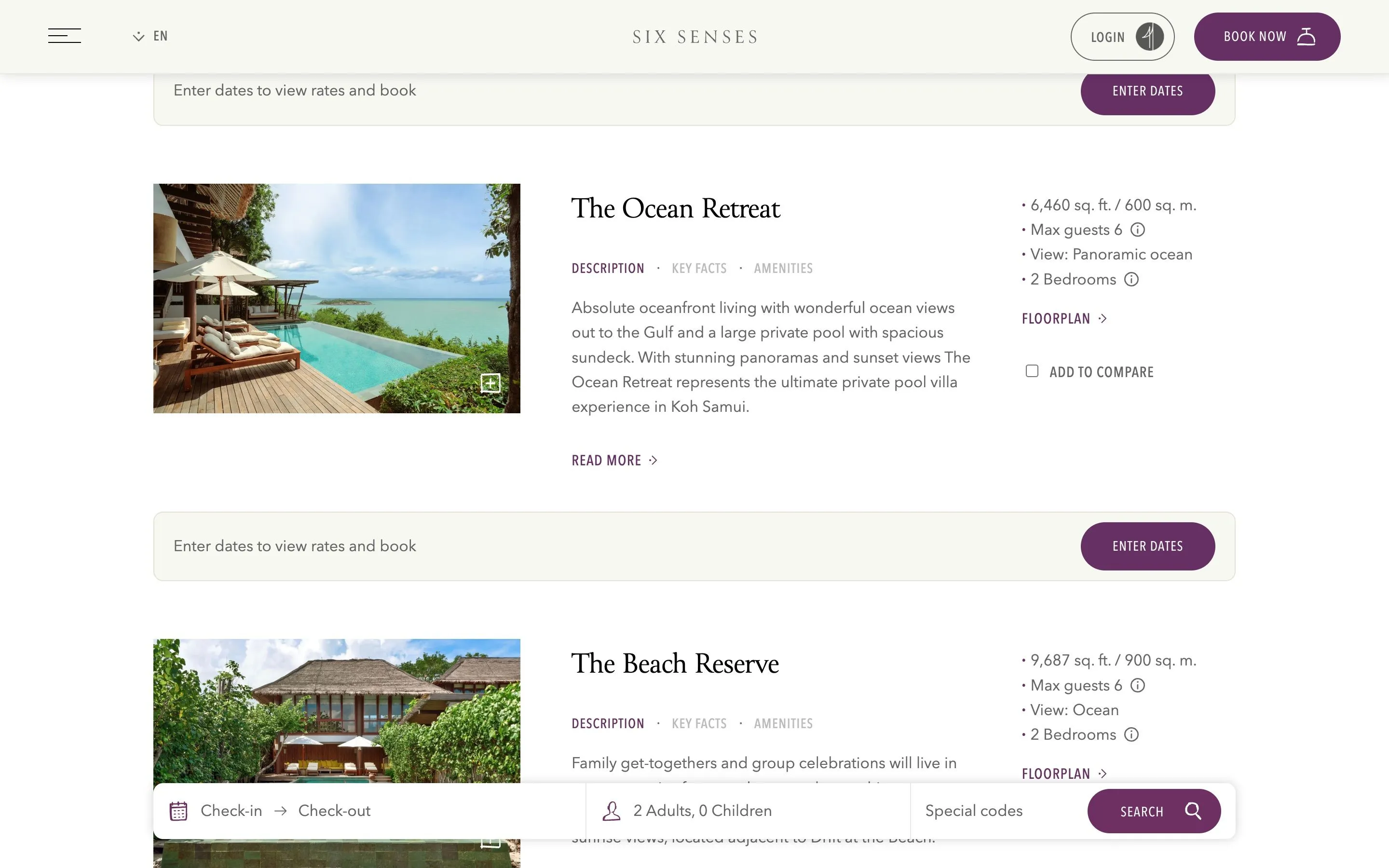
Each Six Senses villa card lists size, guest limit and view, plus links to a floor plan and comparison.
Website: sixsenses.com/samui
Hotel overview: Six Senses Samui has 67 villas on a headland at the northern tip of Koh Samui, 60 of them with private pools. Eight villa types run from 130 sq m to the 600 sq m Ocean Retreat, which sleeps six. The resort is part of the Six Senses group.
Guests get the Six Senses Spa, the Farm on the Hill where they can feed the animals and collect eggs, and ten experiences from temple tours to diving.
Why their website works:
- Full booking bar over the hero video: check-in, check-out, adults and children, a special codes field and a search button. A guest with dates gets prices in one step.
- Villa cards with size, guests and view: size in square feet and square metres, maximum guests, view and bedrooms, so a family rules out villas that are too small before opening any page.
- Floor plan and compare button on each card: “Floorplan” and “Add to compare” let a guest set two villa types side by side and pick between them.
- Transfer prices on the getting-here page: in October 2026, THB 900 per car for up to two guests and THB 1,500 for a minibus for up to six, so guests can budget the whole trip.
3. The Nai Harn, Phuket
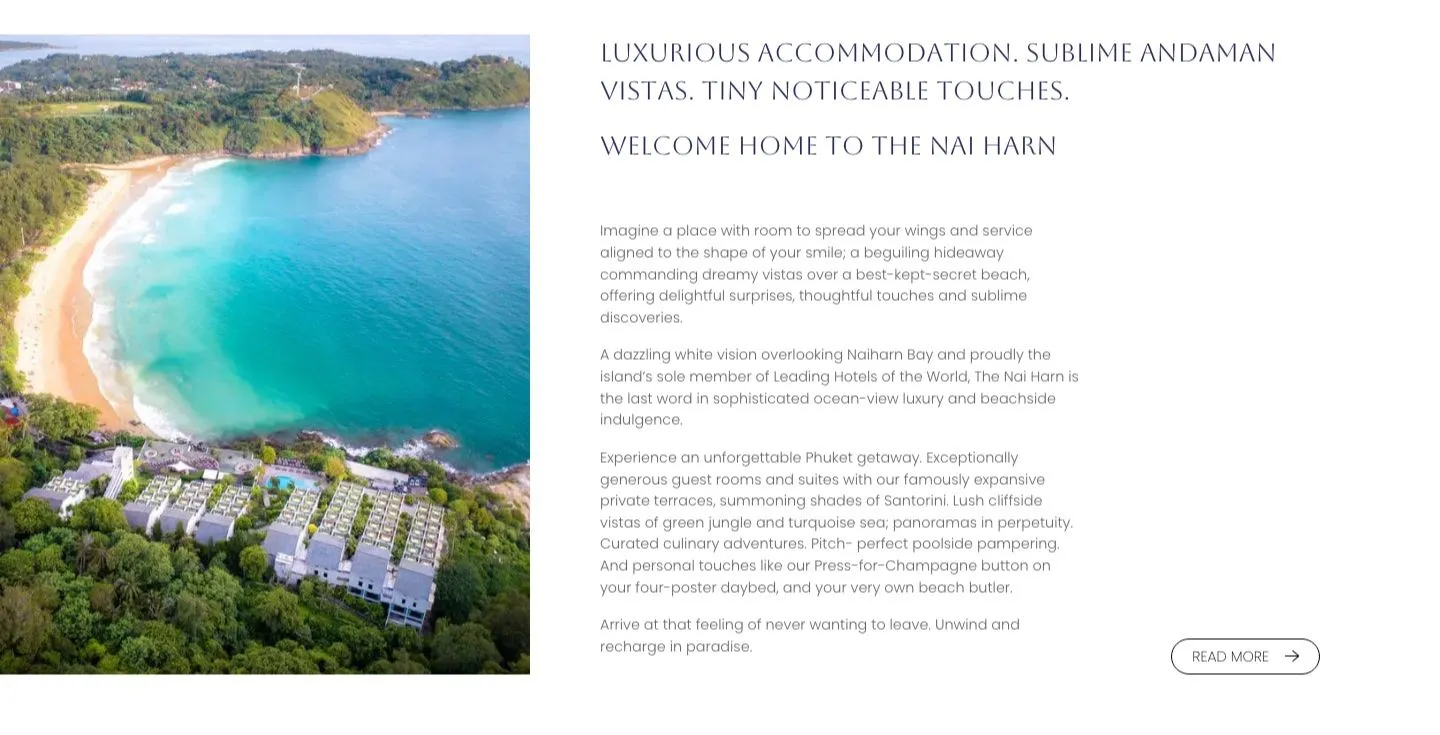
The Nai Harn opens its homepage with an aerial view of the bay and the resort.
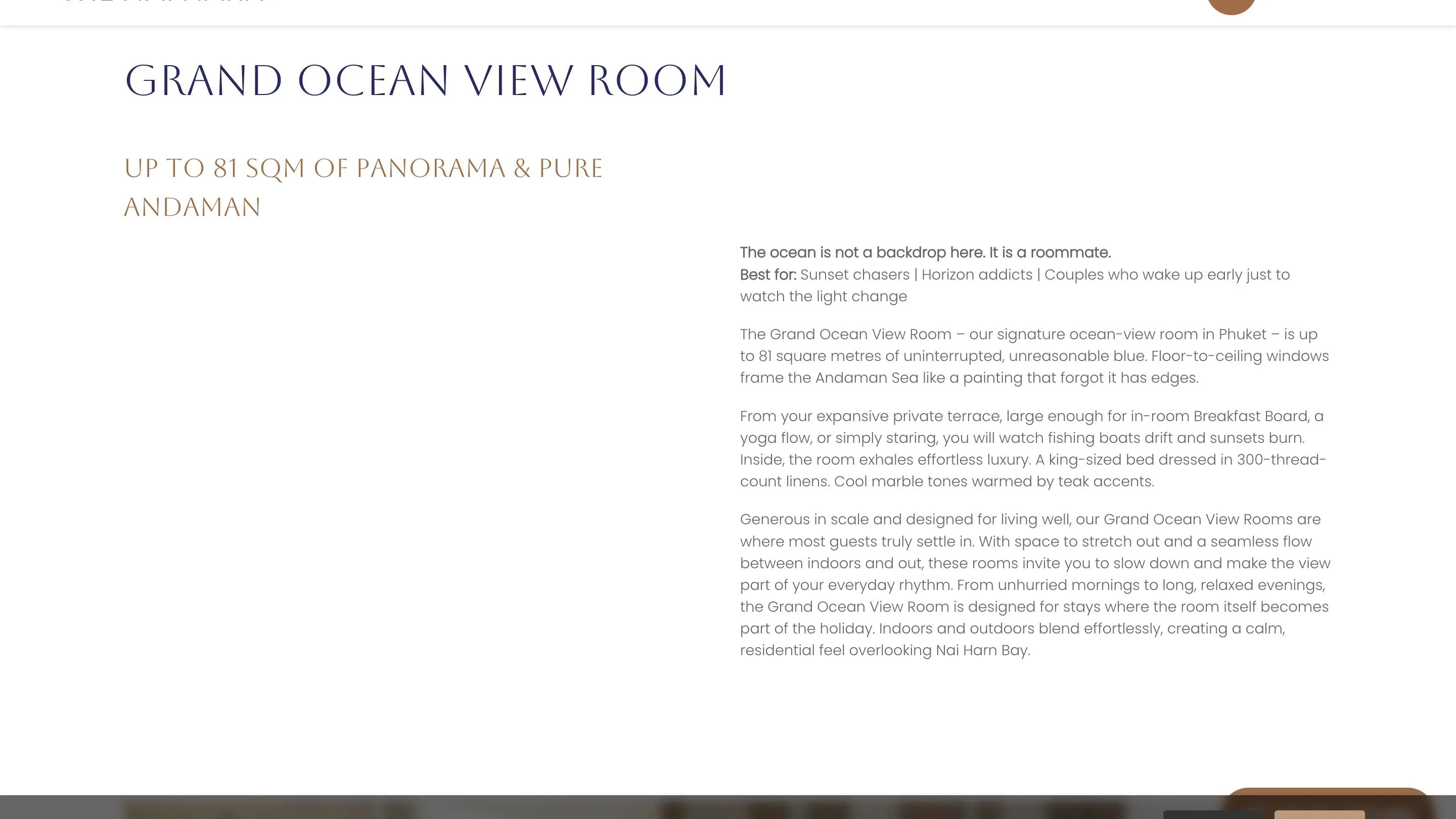
The Grand Ocean View Room page gives the room's size and says which guests it suits best.
Website: thenaiharn.com
Hotel overview: The Nai Harn is a cliffside resort above Nai Harn Bay in the south of Phuket, and the island’s sole member of The Leading Hotels of the World. It calls itself Phuket’s first true luxury resort, and the property has since been renovated. Six room types run from 47 to 111 sqm.
Dining runs from beachside Rock Salt to Hansha, a rooftop sushi bar. The resort holds One MICHELIN Key for 2024, 2025 and 2026.
Why their website works:
- Awards section with names and years: the list includes Travel + Leisure World’s Best Awards 2026, Tripadvisor Travellers’ Choice 2025 and 2026, and Green Hotel Plus Certified 2024, so a guest comparing Phuket resorts can check each claim.
- A subhead that explains why the awards matter: “Badges of honour. Marks of respect. Your peace of mind.” connects the list to the guest’s worry about picking the wrong resort.
- A “Best for” line on each room page: the Grand Ocean View Room is “Best for: Sunset chasers, Horizon addicts, Couples who wake up early just to watch the light change”. A guest matches a room to their trip in one read, beside size and occupancy.
- A named saving for booking direct: “Book Direct and Save up to 10%” on the offers page, backed by a best-rate guarantee on the Q&A page.
4. The Sarojin, Khao Lak
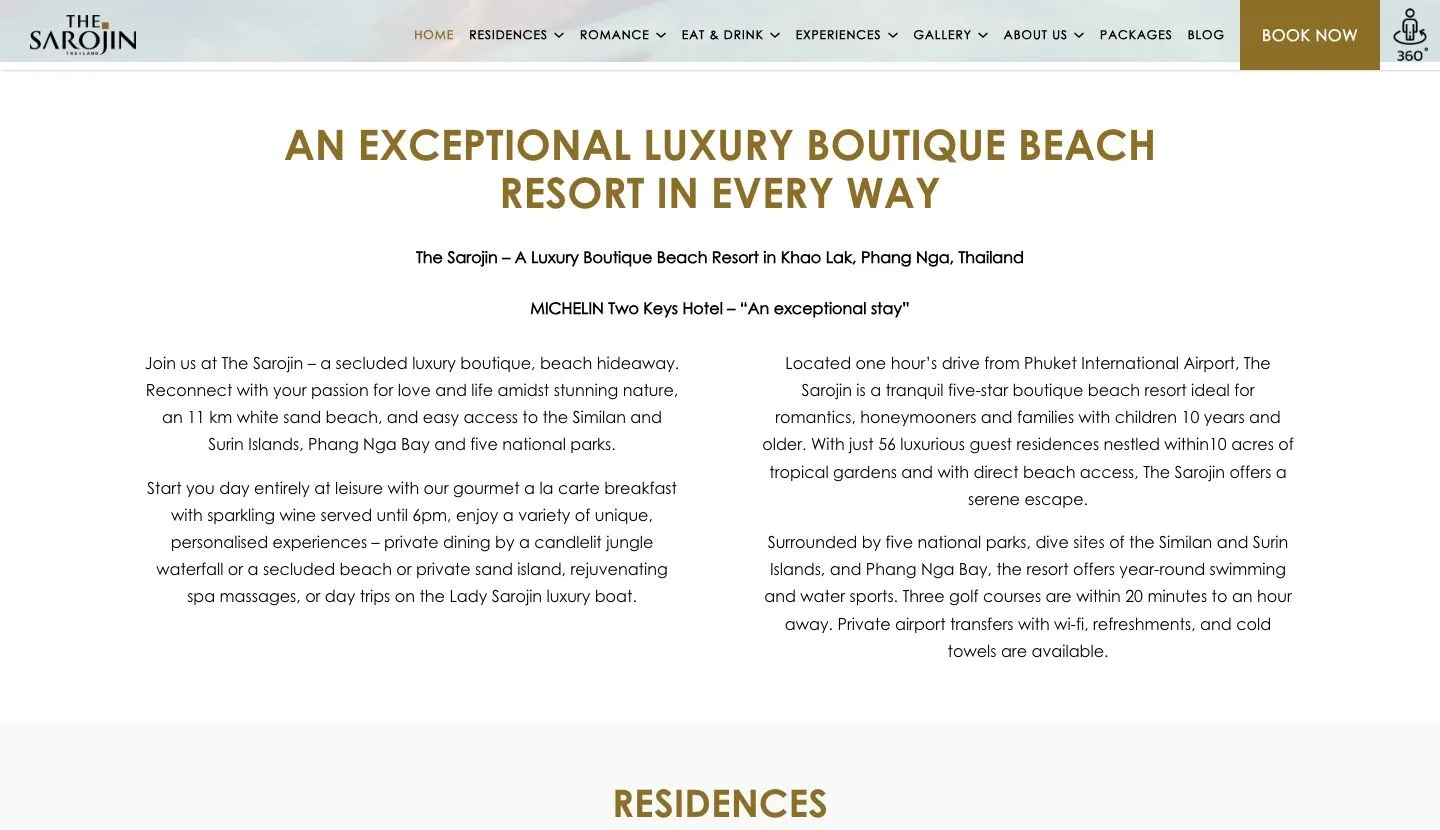
The Sarojin follows its headline with its MICHELIN Keys, then the count and size of each residence type.
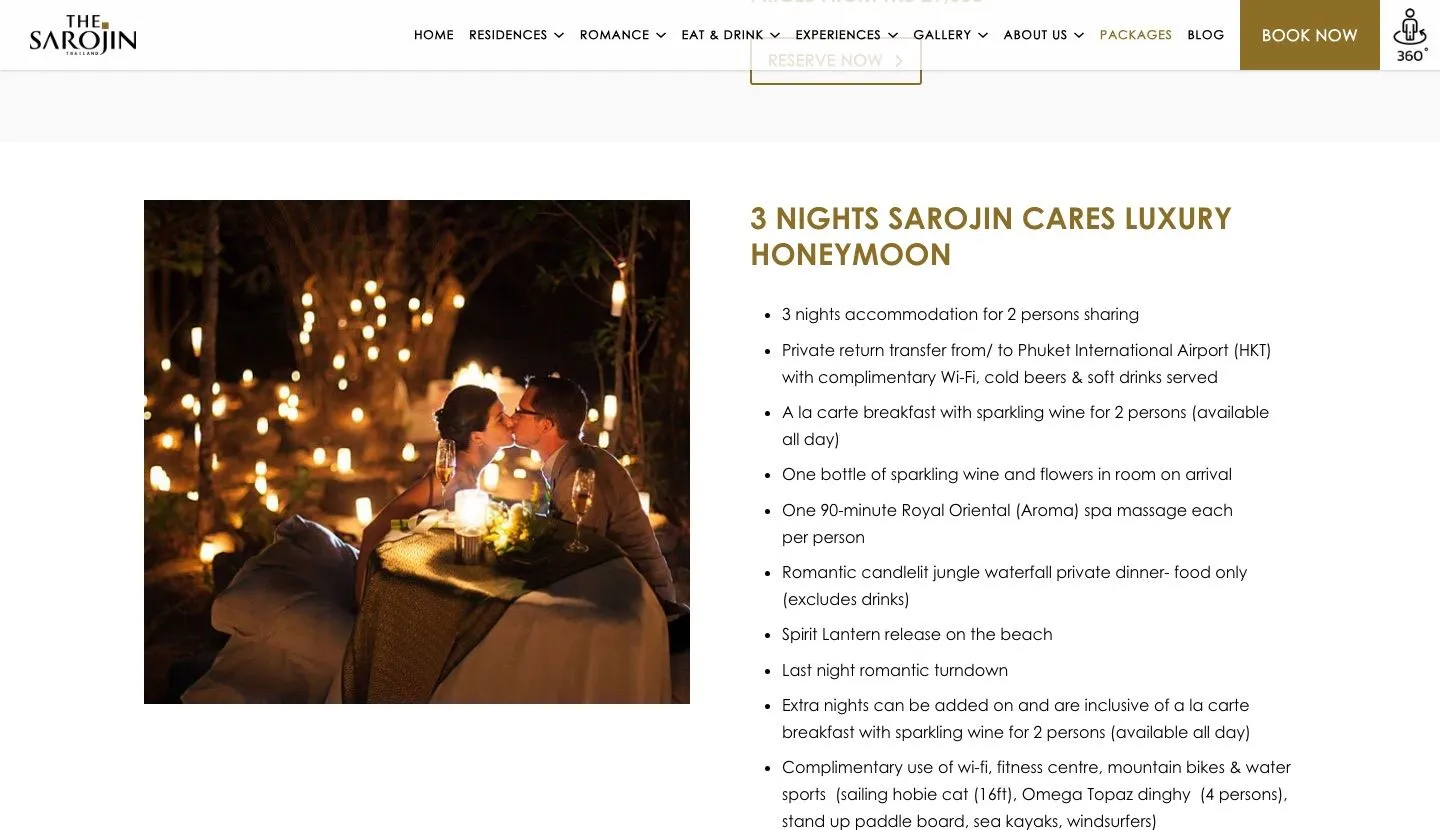
The Sarojin's honeymoon package lists everything included, so couples can book the whole stay at once.
Website: sarojin.com
Hotel overview: The Sarojin is a five-star boutique beach resort in Khao Lak, Phang Nga province, about one hour’s drive north of Phuket International Airport. It has 56 residences in 10 acres of gardens with direct access to an 11 km beach, and welcomes couples, honeymooners and families with children aged 10 and older.
It holds MICHELIN Two Keys for 2024, 2025 and 2026, and was named Thailand’s Leading Boutique Hotel at the World Travel Awards 2025.
Why their website works:
- Headline and MICHELIN line right under the hero: the H1 names the resort type, and the next line says “MICHELIN Two Keys Hotel” before the guest scrolls further.
- Residence cards with counts and sizes: 28 Garden Residences at 95 sqm and 14 Pool Residences at 120 sqm, so a guest sees the scale of the property at a glance.
- Guest limits and inclusions in the room text: the Jacuzzi Pool Suite sleeps four adults or two adults and two children, and the rate includes all-day breakfast for two.
- Distances in kilometres and minutes: the airport is 88.7 km away, Phang Nga Bay is 45 minutes, and the Similan Islands are under an hour by boat.
- Packages built for the main guest type: the Luxury Honeymoon package has three nights, wine and flowers on arrival, a massage each and a private dinner by a jungle waterfall, booked as one stay.
Build a package around your main guest type and list everything it includes, so your guests can book the whole stay in one go.
5. Riva Arun, Bangkok
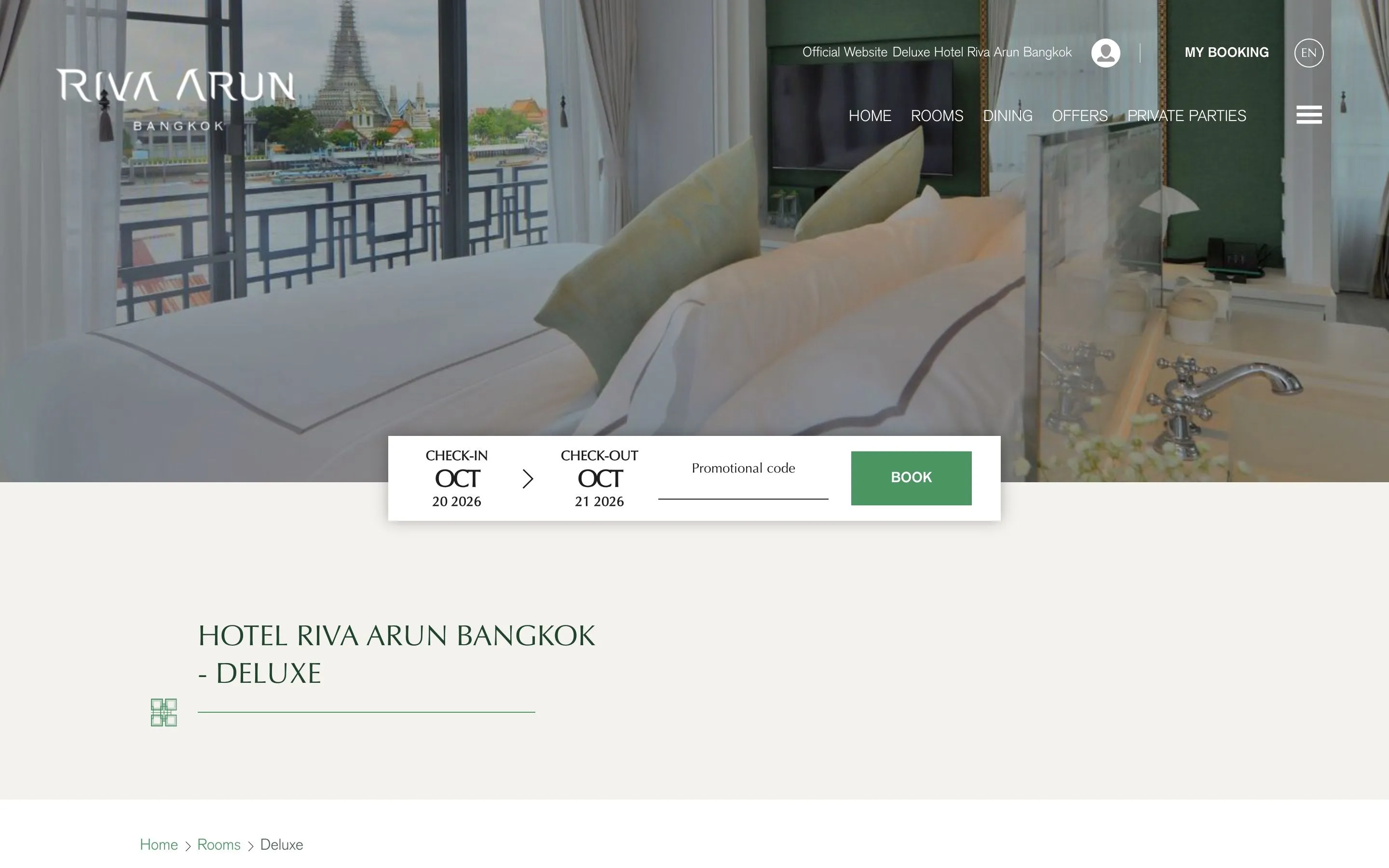
Riva Arun's Deluxe room page keeps the booking bar on top and names the Wat Arun view.
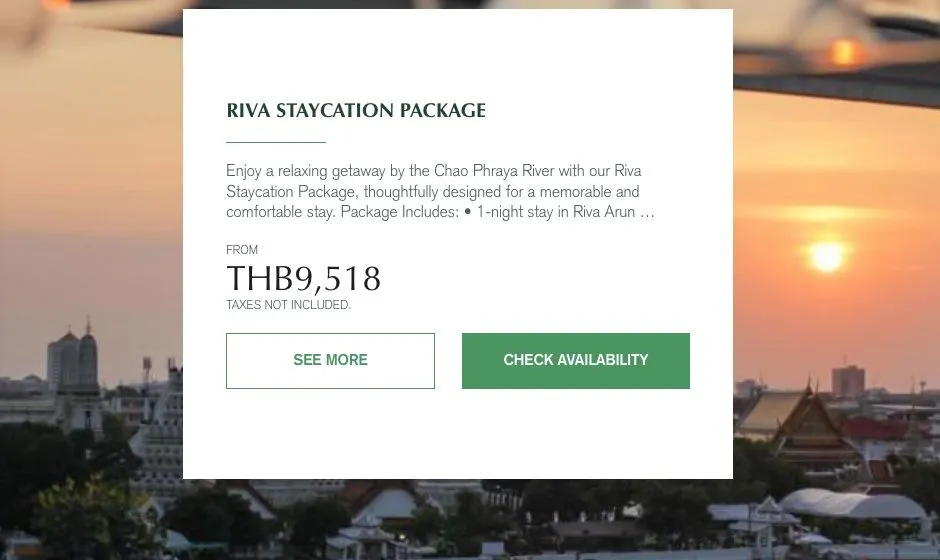
Riva Arun prices its staycation package on the homepage, with taxes noted beside the figure.
Website: rivaarunbangkok.com
Hotel overview: Riva Arun runs 25 rooms on Maharaj Road, on the Chao Phraya River across from Wat Arun, with Wat Pho, the Grand Palace and Museum Siam close by. Six room types in Chino Colonial style run from a 22 sqm Studio to a 73 sqm Premium Jacuzzi Suite.
Guests eat at Above Riva, the rooftop restaurant, or the riverside Lobby Café. The hotel has sister properties, Riva Surya Bangkok and Riva Hua Hin.
Why their website works:
- Booking bar with dates already set: check-in and check-out come filled in at the top of the room page, with a promotional code field and a Book button. One press shows live prices.
- The view named room by room: the Deluxe room has a “mini balcony which overlooks both the river and the iconic Wat Arun”, so a guest picks the room by its view.
- Offers with a starting price: the Riva Staycation Package on the homepage shows its “From” price in THB, with a note that taxes aren’t included, next to a Check availability button.
- Walking distance to the train: the Sanamchai Metropolitan Rapid Transit (MRT) station is “just a mere 250 metres away”, and the site recommends travelling by river boat.
- Tours sold as hotel offers: a river sightseeing cruise, the Bangkok Noi and Yai canal tour and Muay Thai classes can be booked with the room.
6. sala rattanakosin, Bangkok
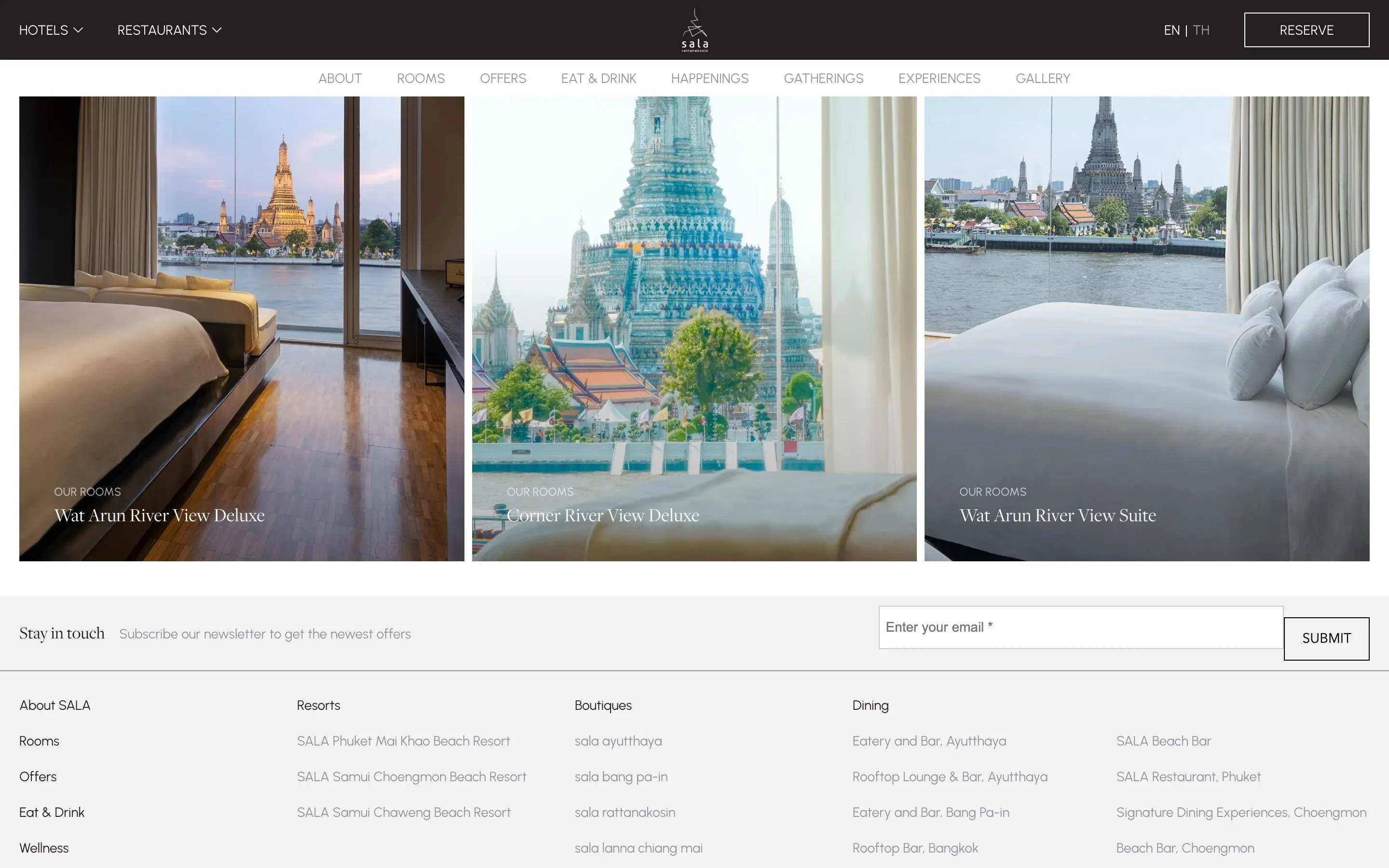
sala rattanakosin names rooms after the temple or river they face, with each room's size and capacity.
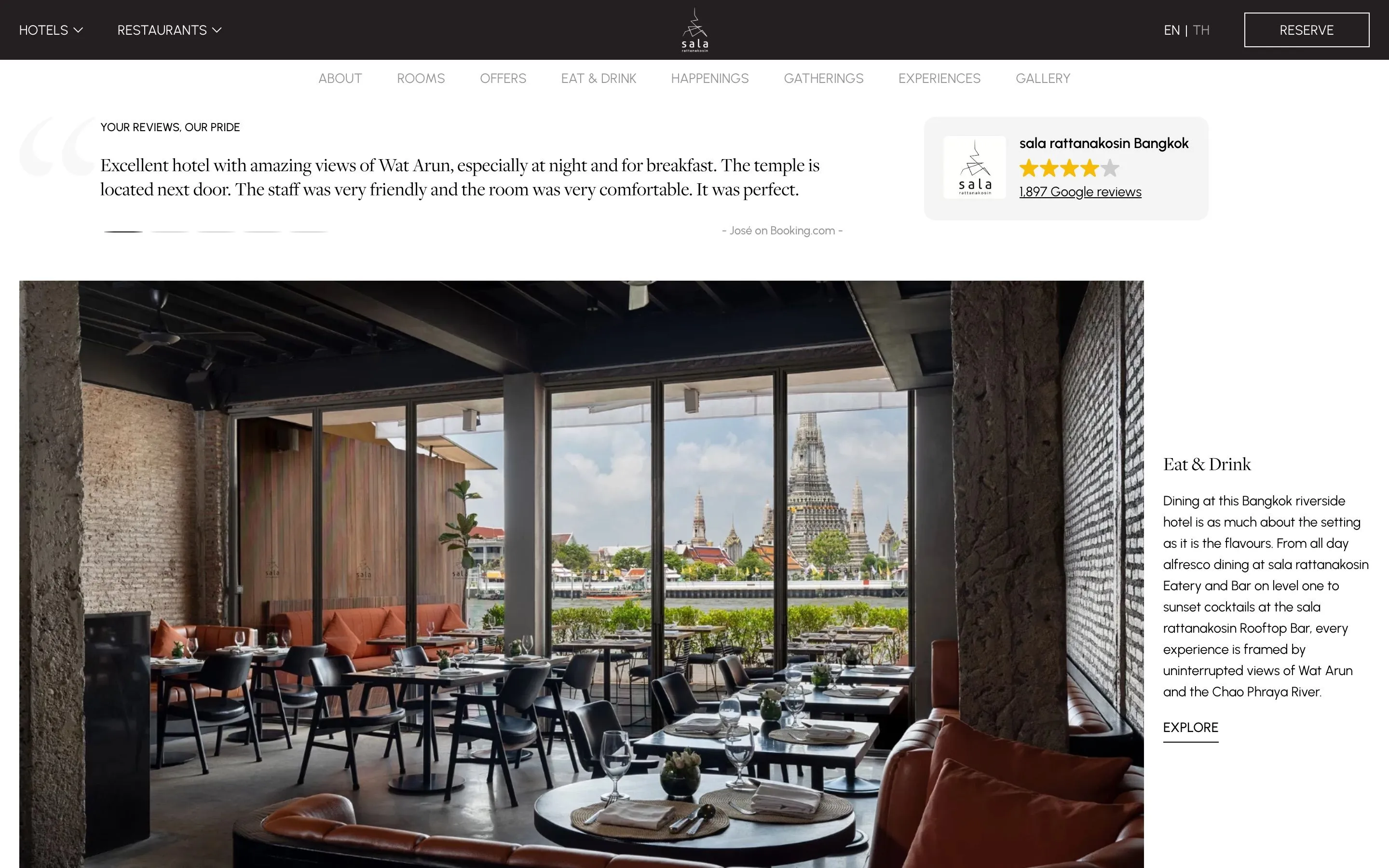
sala rattanakosin credits each guest quote to Google or the travel site it came from.
Website: salahospitality.com/rattanakosin-bangkok
Hotel overview: With 15 rooms at 39 Maharat Road, sala rattanakosin sits on Rattanakosin Island, Bangkok’s old city, facing Wat Arun across the river. Six room types run from 25 to 66 sqm, and four of them sleep three adults, or two adults and a child.
Guests eat at the Riverside Eatery and Bar or the fifth-floor Rooftop Bar, and the hotel hosts events of up to 70 guests. It’s part of SALA Hospitality, a Thai company with eight properties, and holds the Tripadvisor Travelers’ Choice Best of the Best award for 2021.
Why their website works:
- Rooms named by their view: Wat Po Deluxe, Wat Arun River View Deluxe and Corner River View Deluxe, so your guests pick a room by what they’ll see from the window.
- Size, beds and guests on each room: guests travelling with a child can rule rooms in or out quickly instead of emailing to ask.
- Reviews labelled with the site they came from: quotes are credited to Google and three online travel agencies, beside a Google review count, so a guest can check each quote at its source.
- Book-direct benefits listed in one place: best available rates, 10% off accommodation, 10% off dining and complimentary late checkout, all on one page.
Label your own reviews the same way: a quote credited to Google tells your guests more than a badge with no source.
7. Four Seasons Hotel Bangkok at Chao Phraya River, Bangkok
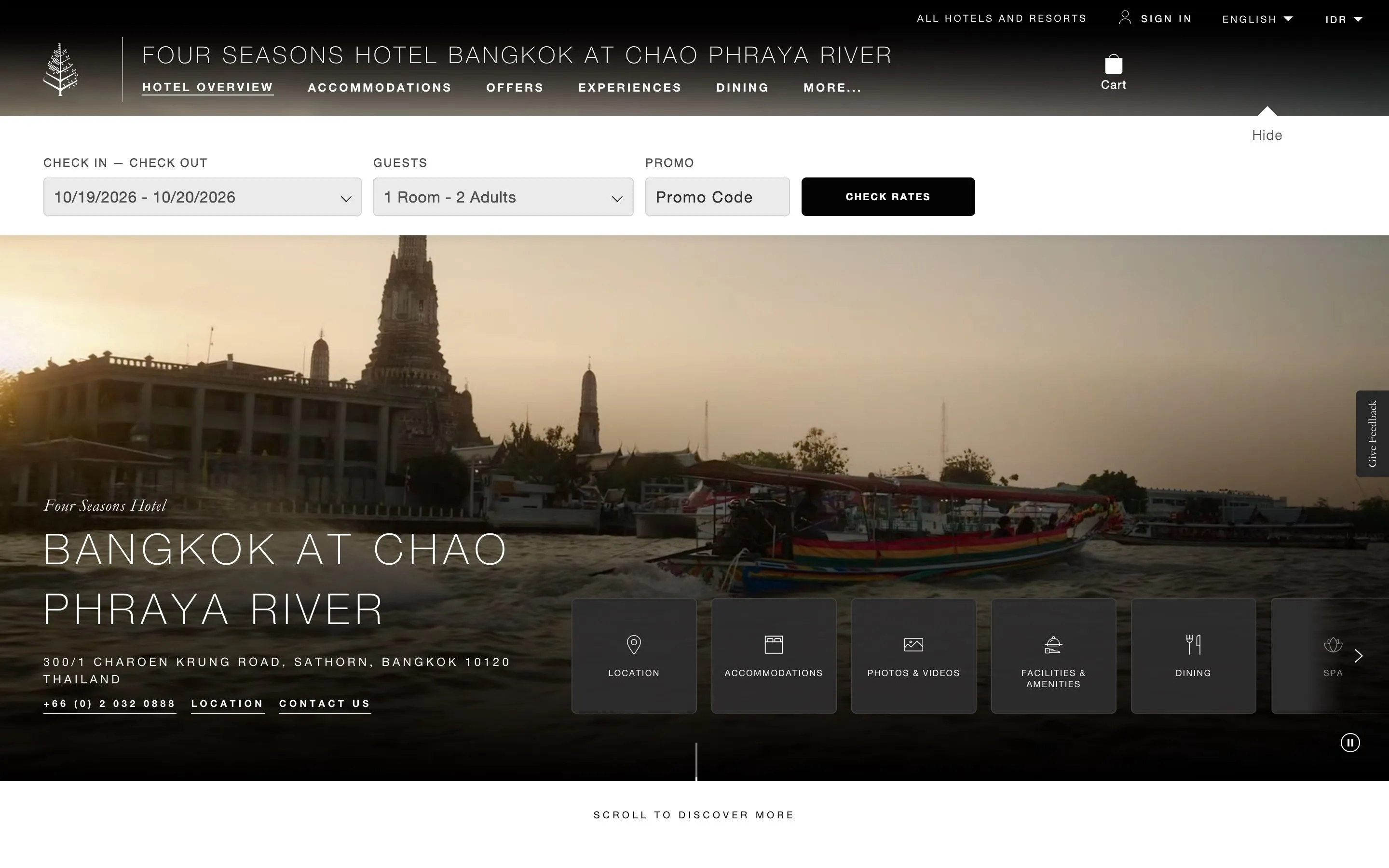
Four Seasons Bangkok shows its address and phone in the hero, above six quick links.
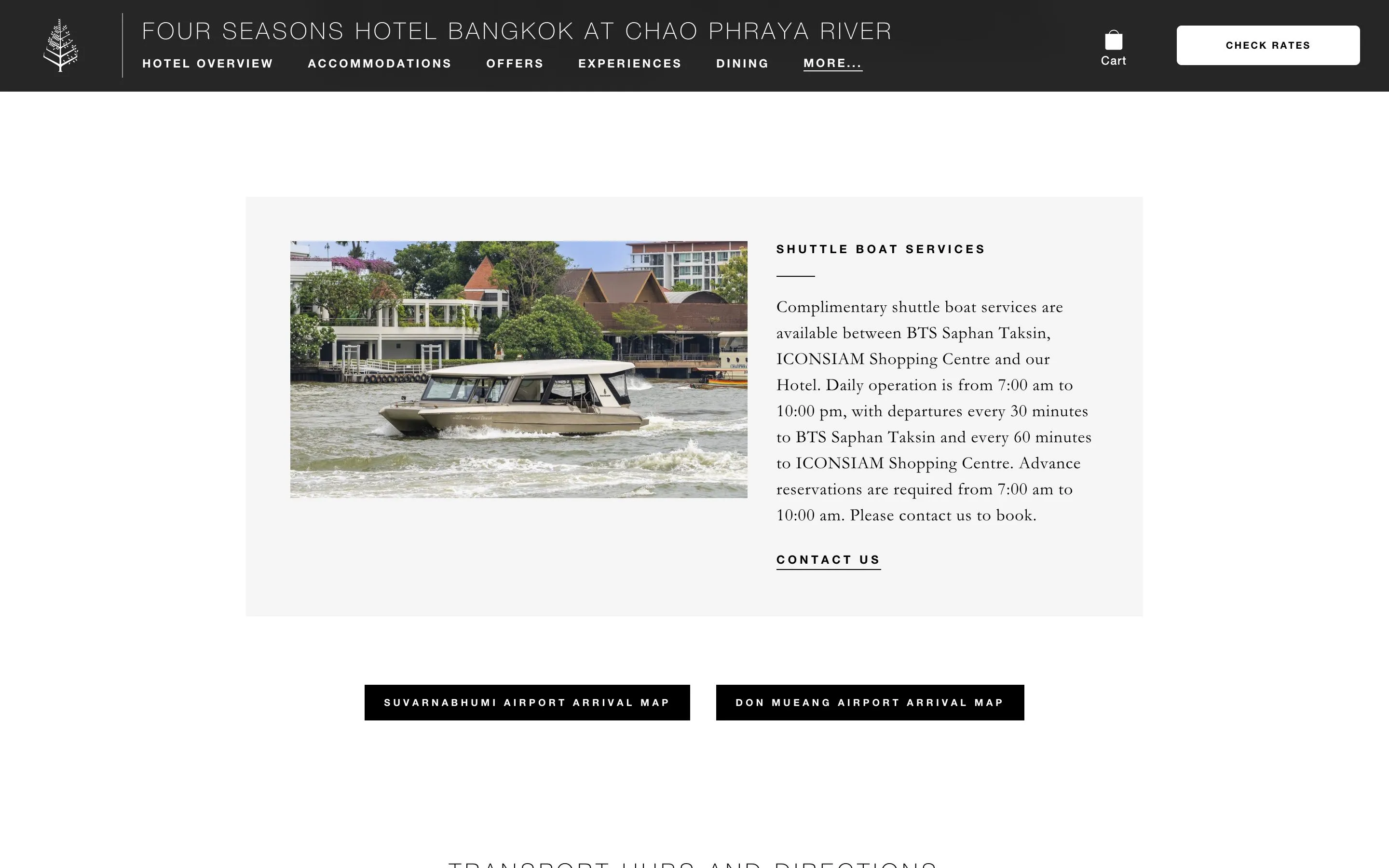
The getting-here page covers the private pier, the shuttle boat and the airport drive, each with a time.
Website: fourseasons.com/bangkok
Hotel overview: The Four Seasons Hotel Bangkok is a 299-room riverside hotel on Charoen Krung Road, in what the hotel calls Bangkok’s creative district. Fifteen room types run from 50 sqm to the 450 sqm Riverfront Penthouse.
Facilities include two infinity pools, a 35-metre lap pool and a 2,500 sqm spa. Restaurants include Yu Ting Yuan and Riva del Fiume, and BKK Social Club was the highest-ranked bar in Thailand on Asia’s 50 Best Bars in 2022 and 2023. There’s 3,401 sqm of event space.
Why their website works:
- Address and phone number in the hero: with Location and Contact Us links. A guest, travel agent or driver gets the practical details first.
- Six quick links under the hero: Location, Accommodations, Photos & Videos, Facilities & Amenities, Dining and Spa, each one a jump link to the page a guest is most likely to want.
- A getting-here page for every route: a private pier, a free shuttle boat every 30 minutes to Bangkok Mass Transit System (BTS) Saphan Taksin, a 40-minute drive from Suvarnabhumi, and the address written in Thai for taxi drivers.
- Room pages with floor plans and virtual tours: beds, occupancy, size, views, floor plan and virtual tour on all 15 types.
8. The Siam, Bangkok
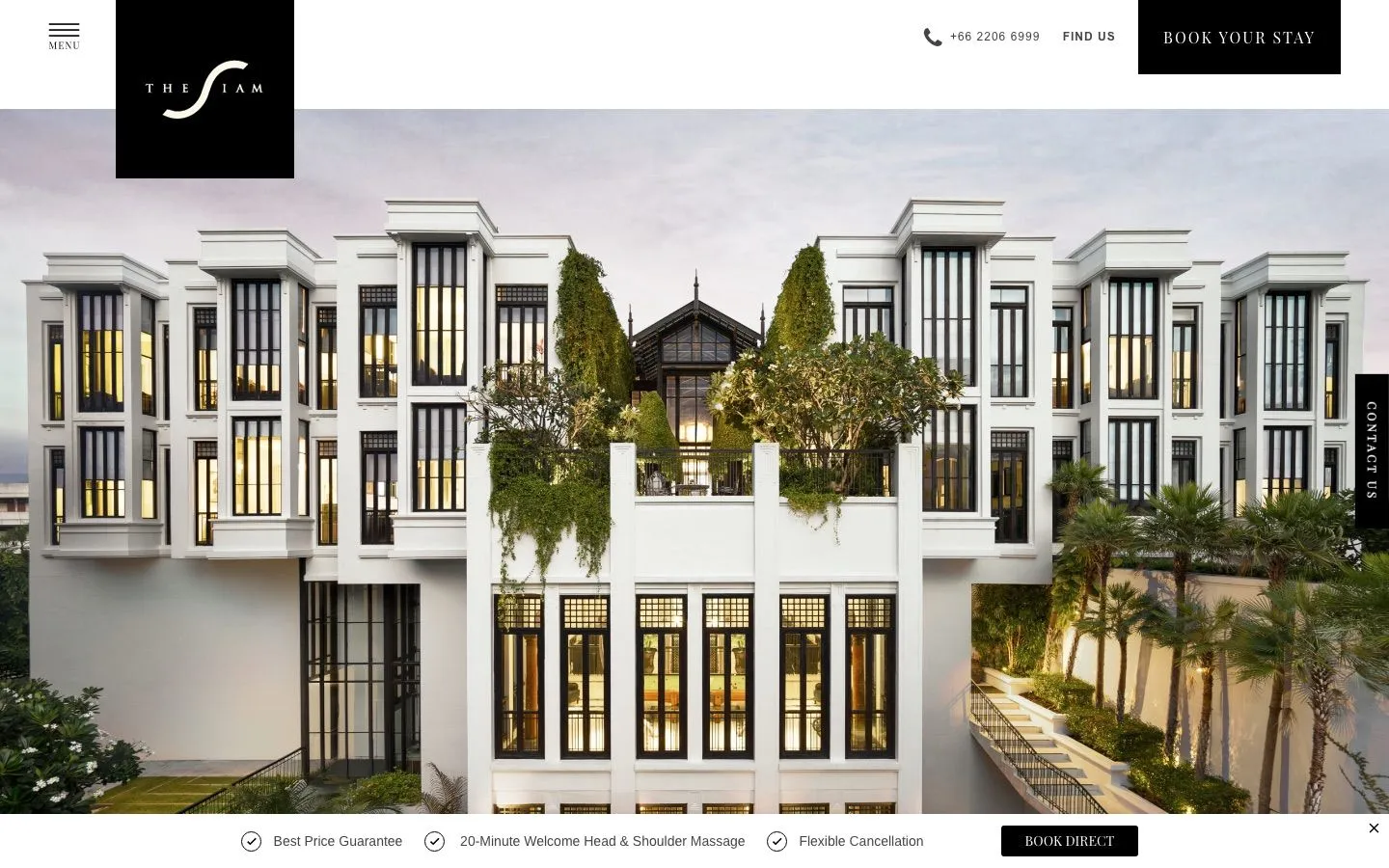
The Siam lists its book-direct perks beside the Book Direct button on the first screen.
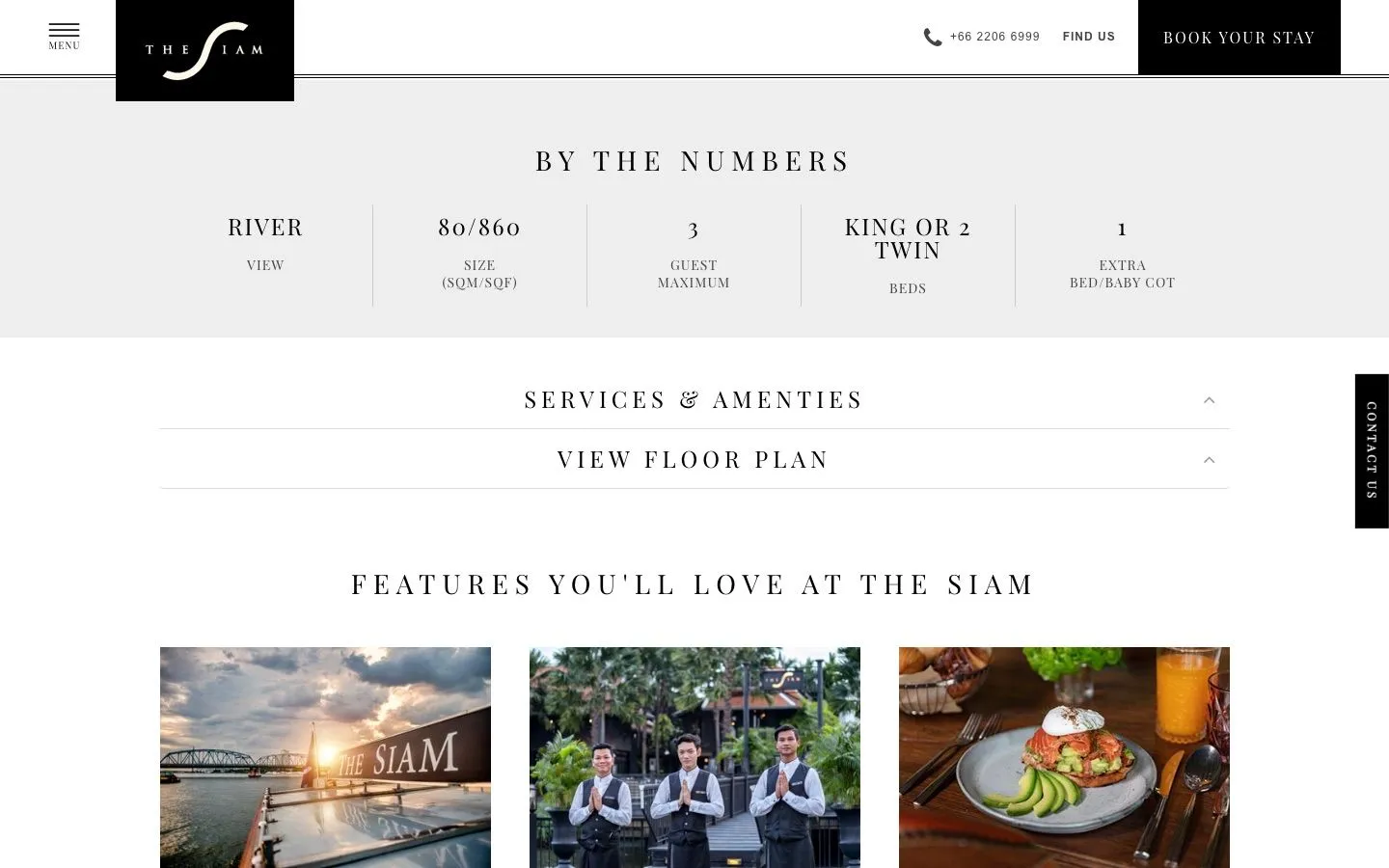
The Siam's suite page sums up size, guests and beds in one panel, plus what every stay includes.
Website: thesiamhotel.com
Hotel overview: The Siam sits in three acres of gardens on the Chao Phraya River in Bangkok’s Dusit district, near the city’s palaces and temples. Its suites and pool villas mix Art Deco style with Thai heritage.
The hotel is part of Sukosol Hotels, run by the Sukosol family, with Krissada Sukosol Clapp as founder and creative director. It holds 3 MICHELIN Keys, awarded in 2024 and 2025, and ranked No. 26 on The World’s 50 Best Hotels 2024.
Why their website works:
- Book-direct bar on the first screen: “Best Price Guarantee”, a “20-Minute Welcome Head & Shoulder Massage” and “Flexible Cancellation” sit next to a “Book Direct” button on the live homepage (checked November 2026).
- Booking button and phone number in the header: “Book Your Stay” and the reservations number sit in the top bar of the homepage.
- A “By the numbers” panel on suite pages: the River View Suite shows 80 sq m, three guests, king or two twin beds, and one extra bed or baby cot.
- What every stay includes, on the room page: daily breakfast, butler service, Wi-Fi and a complimentary boat transfer to a central pier. A guest comparing the direct rate with an online travel agency rate sees what the price covers.
Your own book-direct perks belong in the same place: on the first screen, next to the button your guests press.
What you can learn from the top hotel websites
Here’s what the eight sites do that you can copy on your own hotel site.
- The main selling point goes in names and headlines: sala rattanakosin names rooms after the temple they face, and Riva Arun states the view on each room page. Samujana puts product and island in its headline, and The Sarojin puts its MICHELIN Keys in the second line.
- Travel details come with numbers: Six Senses prices transfers, Four Seasons gives shuttle frequency and drive time, Riva Arun measures the walk in metres, and The Sarojin gives kilometres.
- Pages are written for the main guest type: Samujana lets groups of up to 16 search in one go. The Nai Harn tells couples which room suits sunset watchers, and The Sarojin and sala state which rooms take children.
- Offers sell the extras a guest would book elsewhere: Riva Arun’s tours, The Sarojin’s honeymoon package, and The Siam’s breakfast, butler and boat in every stay.
When you brief an agency, ask for these points by name, and use the questions in how to choose a web design agency before you sign.
A resort homepage we designed for more direct bookings
We designed this homepage concept for Amrisa Resort, a beach resort in Phuket, to show these patterns together. The headline reads “A serene retreat of natural luxury”, and the line under it says: “Thai pavilions and pool villas on a private headland in Phuket, each facing the Andaman Sea, 25 minutes from the airport.”
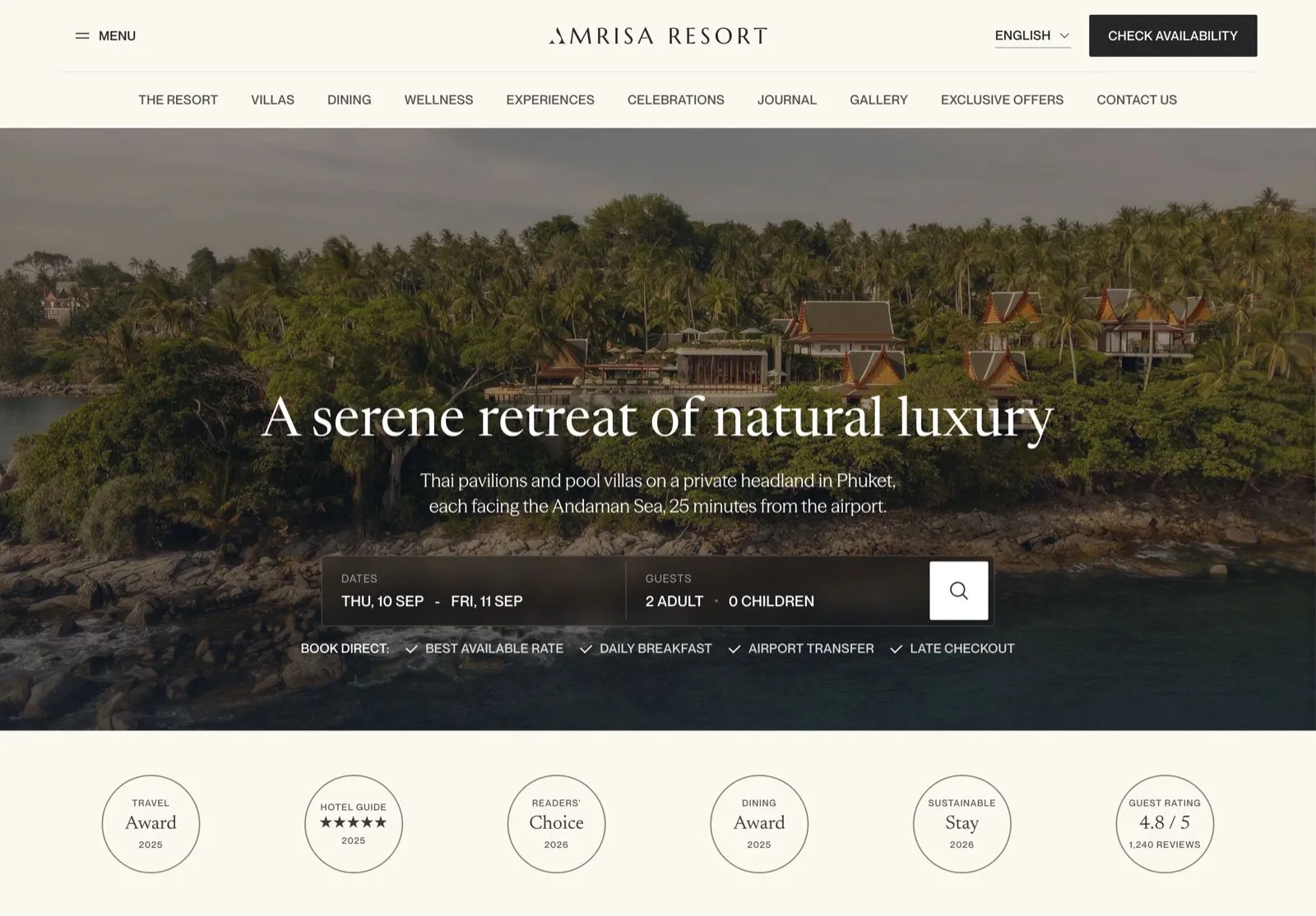
Our Amrisa concept puts the book-direct perks under the booking bar on the first screen.
- A first screen that sells the stay and the direct booking: under the headline, the booking bar takes dates and guests, and the line beneath it reads “Book direct: Best available rate, Daily breakfast, Airport transfer, Late checkout”.
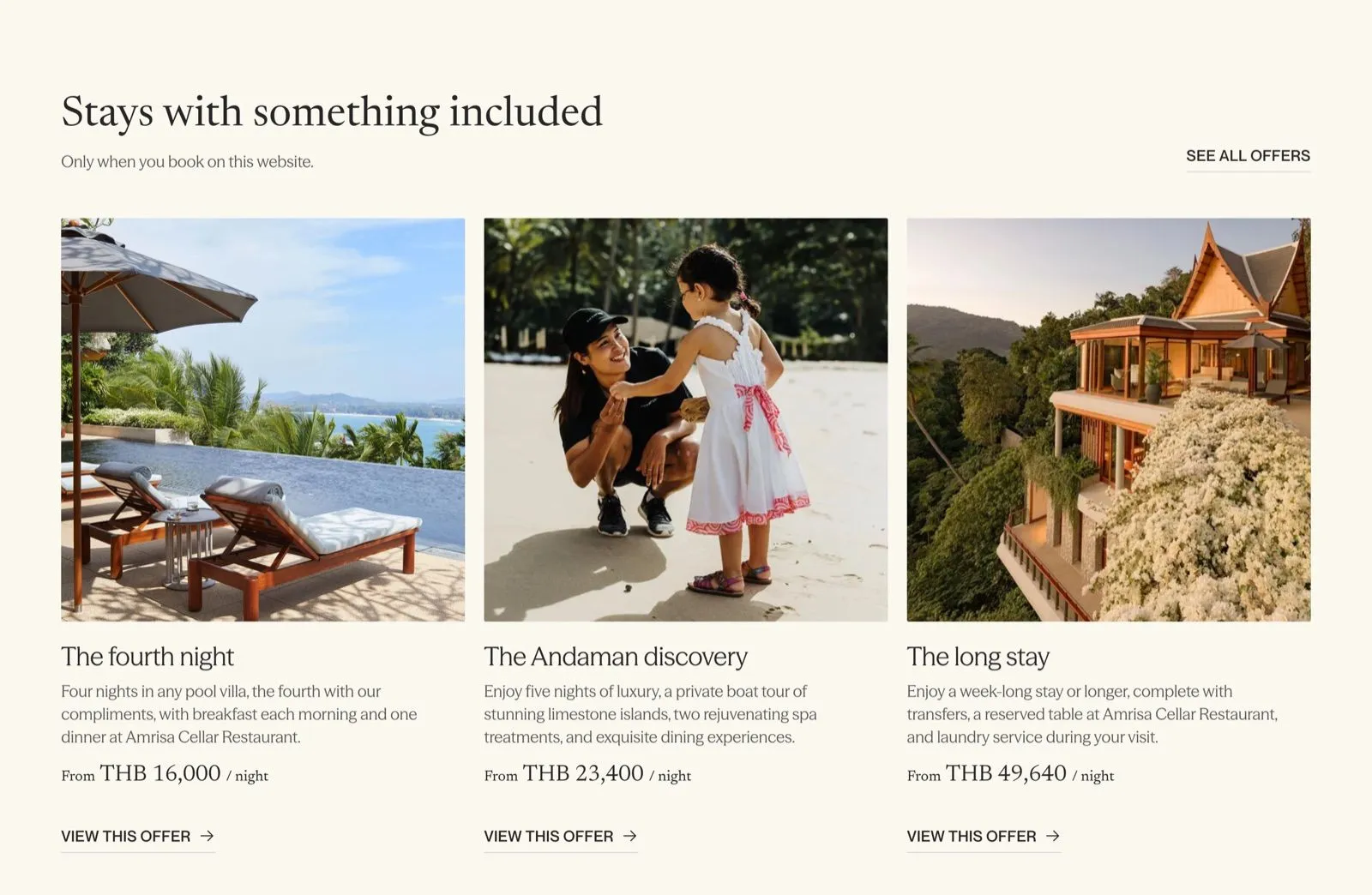
Amrisa's offers each carry a price and a note that they're only on the resort's own site.
- Offers that state what direct booking adds: the “Stays with something included” section carries the line “Only when you book on this website” under the heading, and a price on every offer, from THB 16,000 to THB 49,640 a night. The guest sees what booking direct adds before scrolling to rooms.
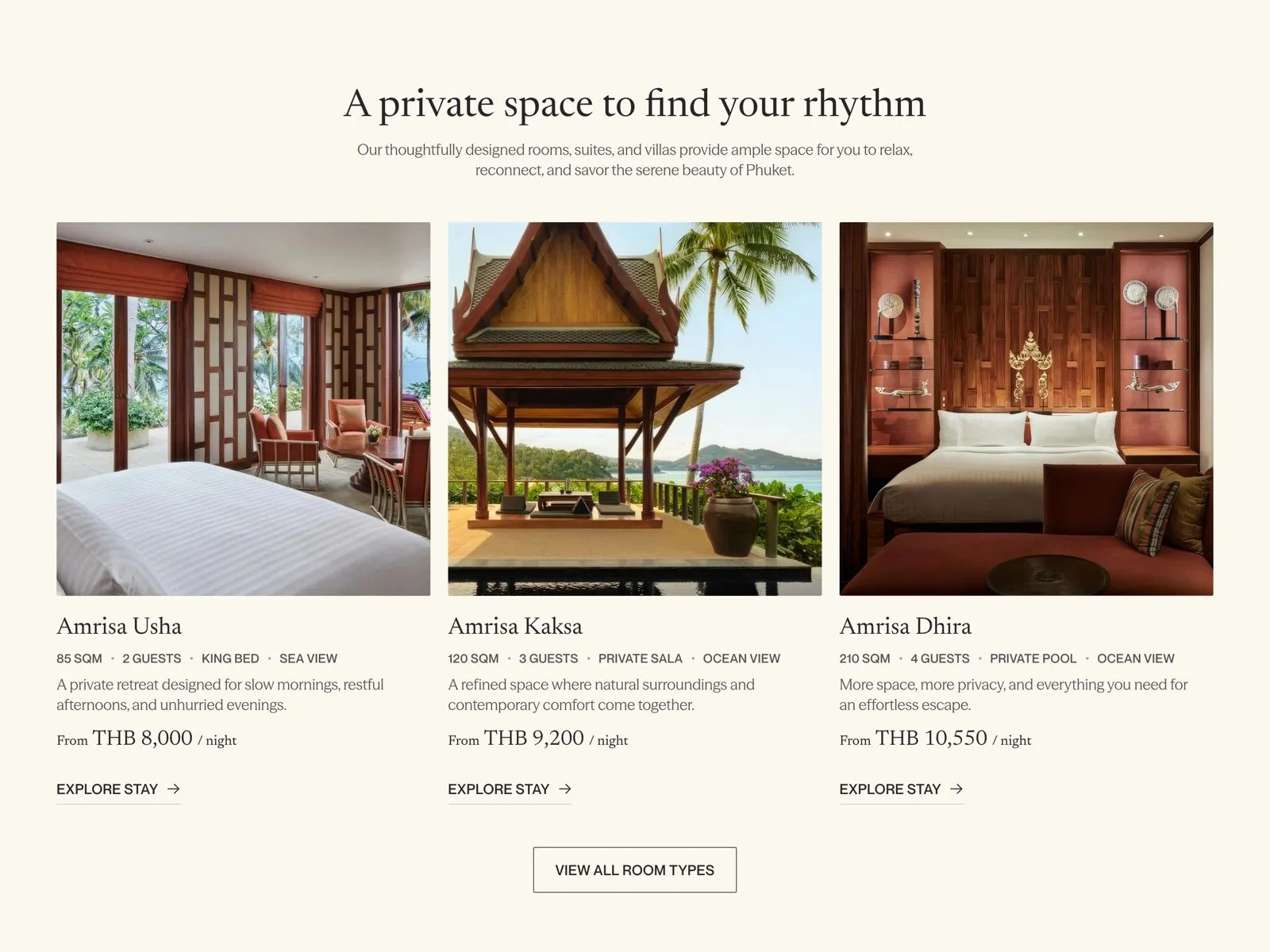
Amrisa's villa cards answer the questions guests ask before they look at the price.
- Room facts above the rate: each villa card gives size, guests, a key feature and the view above the rate. The Amrisa Kaksa card reads “120 sqm, 3 guests, Private sala, Ocean view”. A guest compares villa types side by side without opening each page.
You can copy three parts on your own homepage. Name the kind of stay, the island and the drive time under the headline. Put a book-direct line under the booking bar, and give every offer a price and a note that it’s only on your website.
How to build a hotel website that gets more direct bookings
There are three routes to a hotel site, and the one that fits depends on your property and your budget. On every route, two things matter: which booking engine you connect, and who keeps rates and offers current.
| Route | Cost | Time | What you get | Who it fits |
|---|---|---|---|---|
| Do it yourself on a website builder | Monthly plan plus booking engine fees | A few weeks of your own team's time | A template site you edit yourself, booking engine linked or embedded | A guesthouse or homestay with someone in-house to write and take photos |
| Template package from a small Thai studio | About THB 18,500 to THB 20,000, some with a monthly fee of about THB 3,000 | About 1 month | A preset design adjusted to your brand, a few pages, contact form, basic search engine optimisation (SEO) setup, you supply text and photos | A small hotel with clear content that needs a tidy site quickly |
| Agency | About THB 89,000 to THB 850,000 or more, depending on pages, languages and booking setup | About 3 to 6 months | Custom design, a planned sitemap, copy for every page, room pages built around your guests, booking engine connection, extra languages on larger builds | Resorts and boutique hotels where each extra direct booking saves a large commission. Superpresence works this way, with research, copy for every page and design planned around direct bookings |
On every route, website cost moves most with the number of room types, languages and how the booking engine connects. If you take the agency route, ask to see a hotel site the agency built and how its booking engine connects.
Now check your website: will it win the booking?
Open your own site on a phone, the way a guest does after leaving an online travel agency listing. Check that the first screen says what your hotel is and where, and that a booking bar sits at the top.
Then check that your reason to book direct sits next to that bar. The direct booking is won or lost on that first screen, before a guest ever opens a room page.
If you’d like to see that on your own site, ask for our free homepage hero redesign. We’ll redo the top of your homepage with the booking bar and your reason to book direct in place.
FAQ
Do I need a booking engine on my hotel website?
Yes, if you want guests to book without phoning or emailing. Pick a booking engine that connects to your property management system or channel manager, so rooms stay in sync with your online travel agency listings. Then put its booking bar on the first screen of your homepage, where guests look for it.
Which languages should a hotel website in Thailand have?
Start with English and Thai, then add the languages of your largest guest markets, which you’ll find in your booking data. Add only the languages your team can keep current, so every version shows the same rates and offers.
Do I still need online travel agencies if my website gets direct bookings?
Yes. Online travel agencies bring you guests who don’t know your hotel yet, and your site’s job is to win the ones who check your website after finding you on a listing. Give them a reason to book direct when they arrive, and keep your listings and your site showing the same room facts.
How often should a hotel update its website?
Check rates, offers and notices every month, and remove ended offers as soon as they end. Add new awards with their year when you receive them. Update room photos after any renovation, so what your guests see on the site matches what they find when they arrive.
Written by

From Sydney, Australia with a decade in Asia, Kevin built his expertise driving product and growth at tech startups across fintech, logistics, consumer apps, and crypto. He founded SuperPresence with this expertise and passion, helping businesses create high-converting web experiences and digital growth strategies that drive real revenue impact.
Share this article